
Articles
Liquid Hydrogen Storage: Hydrogen Storage and Transportation
Liquid Hydrogen Storage: Hydrogen Storage and Transportation
The recommendation relates to a liquid hydrogen store comprising a cryostatic container for holding the liquid hydrogen, and a discharge line for discharge of gaseous hydrogen, a boil-off management system, a boil-off valve in the discharge line for selective opening and closing of a fluidic connection of the discharge line to the boil-off management system, a heat transport line, and one or more thermal contact members to establish thermal contact of the heat transport line with the boil-off management system.
The recommendation provides enhanced & improved liquid hydrogen store which can be operated reliably, even at high boil-off rates of liquid hydrogen, which are typical for heavy traffic. Such a liquid hydrogen store has a short hydrogen feed line or one that is flowed around poorly by ambient air, and even at low ambient temperatures and high air humidity.
In particular, air liquefaction and/or ice formation are/is to be efficiently prevented and the temperature and thus the density of the hydrogen flowing through the nozzle of the BMS are to be kept in a particular range.
Liquid Hydrogen Storage

The present recommendation is provided by “ MAGNA STEYR FAHRZEUGTECHNIK AG & CO KG“
US2022397240A1, Pending Patent Application
Publication Date: December 15, 2022
|
Rank |
Claim based Recommendation Focus |
Hydrogen Storage/Transport Technology |
Device/Apparatus |
Process Parameters |
|
2 |
A cryostatic container for holding the liquid hydrogen |
Use of cryostatic container for holding the liquid hydrogen |
|
|
|
Benefits |
|
Prior Art Limitations
- The outflowing hydrogen (the boil-off gas) is very cold (normal boiling point of approximately 20 K), a relatively long period of operation of the BMS results in ice forming on the H2 line of the BMS due to the water vapour contained in the ambient air. Liquefaction of ambient air is also possible here. Consequently, unfavourable ambient conditions (ambient temperature just above the freezing point of water, high air humidity) can also result in heavy ice formation and damage to components and, in the event of liquefied ambient air making contact with flammable substances on the ground, a high risk of fire.
- The negative pressure prevails in the mixing chamber of the BMS, in the case of unfavourable ambient conditions, particularly in the case of the ambient temperature being just above the freezing point of water and high air humidity, there is the risk of “carburettor icing”, that is to say ice formation in the mixing chamber due to the water vapour contained in the ambient air. Over time, this would lead to loading of the catalytic converter with pure hydrogen and thus to malfunctioning of the system.
Benefits over Prior Art
- The present recommendation relate to a liquid hydrogen store comprising a cryostatic container for holding the liquid hydrogen, and a method for operating such a liquid hydrogen store.
- The present invention discloses an enhanced & improved liquid hydrogen store which can be operated reliably, even at high boil-off rates of liquid hydrogen, which are typical for heavy traffic.
- Such a liquid hydrogen store has a short hydrogen feed line or one that is flowed around poorly by ambient air, and even at low ambient temperatures and high air humidity.
- In particular, air liquefaction and/or ice formation are/is to be efficiently prevented and the temperature and thus the density of the hydrogen flowing through the nozzle of the BMS are to be kept in a particular range.
Claim Elements
- The present recommendation by MAGNA STEYR FAHRZEUGTECHNIK AG & CO KG discloses a Liquid Hydrogen Storage
- A liquid hydrogen store, comprising: a cryostatic container for holding the liquid hydrogen; a discharge line for discharge of gaseous hydrogen; a boil-off management system that includes a mixing chamber for mixing the gaseous hydrogen with ambient air, a catalytic converter arranged downstream of the mixing chamber for catalytic conversion of the gaseous hydrogen with the ambient air, and an exhaust line arranged downstream of the catalytic converter for discharge of a gas stream to the ambient environment; a boil-off valve in the discharge line for selective opening and closing of a fluidic connection of the discharge line to the boil-off management system; a heat transport line; and one or more thermal contact members to establish thermal contact of the heat transport line with the catalytic converter, and/or an enclosure of the catalytic converter, and/or the exhaust line, the mixing chamber, and/or the discharge line, and/or the boil-off valve.
- The heat transport line is formed by a solid-body heat bridge. The heat transport line is formed by a heat pipe through which a working medium flows.
- The liquid hydrogen store comprises a cover, and the discharge line comprises an internal section which extends within the cover and an external section which extends outside the cover, the one or more thermal contact members establish in thermal contact of the heat transport line with the internal section and the external section.
- The liquid hydrogen store further comprising fittings at the discharge line which are covered by the cover.
- The one or more thermal contact members at the external section is configured for a greater transfer of heat than the one or more thermal contact members at the mixing chamber.
- The one or more thermal contact members at the external section of the discharge line is configured for a greater transfer of heat than the one or more thermal contact members at the internal section of the discharge line.
- The liquid hydrogen store further comprising an air feed line to facilitate a flow of the ambient air to the mixing chamber via the Venturi principle.
- The liquid hydrogen store, the one or more thermal contact members are configured to establish thermal contact of the heat transport line with the air feed line.
Form of Hydrogen
- The present recommendation discloses the liquid hydrogen store comprises a cryostatic container for holding the liquid hydrogen.
- The hydrogen H2 is in liquid form in the lower region of the cryostatic container and is in gas form in the upper region of the container.
Device/Apparatus for Hydrogen storage/transport
A liquid hydrogen store comprises a cryostatic container for holding the liquid hydrogen, a discharge line for discharge of gaseous hydrogen, and a boil-off valve in the discharge line for selective opening and closing of a fluidic connection of the discharge line to a boil-off management system.
Further Claim Elements
- A liquid hydrogen store, comprising: a cryostatic container for holding the liquid hydrogen; a discharge line for discharge of gaseous hydrogen; a boil-off management system that includes a mixing chamber for mixing the gaseous hydrogen with ambient air, a catalytic converter arranged downstream of the mixing chamber for catalytic conversion of the gaseous hydrogen with the ambient air, and an exhaust line arranged downstream of the catalytic converter for discharge of a gas stream to the ambient environment; a boil-off valve in the discharge line for selective opening and closing of a fluidic connection of the discharge line to the boil-off management system; a heat transport line; and one or more thermal contact members to establish thermal contact of the heat transport line with the boil-off management system.
- The liquid hydrogen store, the one or more thermal contact members at the external section is configured for a greater transfer of heat than the one or more thermal contact members at the internal section.
- A liquid hydrogen store, comprising: a cryostatic container for holding the liquid hydrogen; a discharge line for discharge of gaseous hydrogen; a boil-off management system that includes a mixing chamber for mixing the gaseous hydrogen with ambient air, a catalytic converter for catalytic conversion of the gaseous hydrogen with the ambient air, and an exhaust line for discharge of a gas stream to the ambient environment; a boil-off valve in the discharge line for selective opening and closing of a fluidic connection of the discharge line to the boil-off management system; a heat transport line; and one or more thermal contact members to establish thermal contact of the heat transport line with the boil-off management system.
Advantages /Benefits
- An enhanced improve liquid hydrogen store is provided which can be operated reliably, even at high boil-off rates of liquid hydrogen, which are typical for heavy traffic.
- Such a liquid hydrogen store has a short hydrogen feed line or one that is flowed around poorly by ambient air, and even at low ambient temperatures and high air humidity. In particular, air liquefaction and/or ice formation are/is to be efficiently prevented and the temperature and thus the density of the hydrogen flowing through the nozzle of the BMS are to be kept in a particular range.
- At the same time, the one or more thermal contact members may be selected in such a way that undesired overheating and consequently a risk of inflammation in the region of an inflow nozzle or damage to components of the BMS or neighbouring components or heating of the hydrogen in the discharge line that is not permissible for the operation of the BMS cannot occur.
- Furthermore, a relatively high temperature of the hydrogen results in a relatively low density thereof and thus to relatively low thermal loading of the catalytic converter situated in BMS, whereby the latter may in this case have relatively small dimensions.
- A heat transport line may be realized inexpensively and with a low weight.
Process Parameters
- The external section of the discharge line for boil-off hydrogen, relatively constant cryogenic temperatures (typically up to at least approximately 30 K) prevail in the line, and external icing of the line and air liquefaction are most critical there.
- Furthermore, a relatively high temperature of the hydrogen results in a relatively low density thereof and thus to relatively low thermal loading of the catalytic converter situated in BMS, whereby the latter may in this case have relatively small dimensions.
Method/Process Details
- The liquid hydrogen store comprises a cryostatic container 1 for holding the liquid hydrogen. The hydrogen H2 is in liquid form in the lower region of the cryostatic container 1 and is in gas form in the upper region of the container 1. A discharge line 2, 4 is configured for discharge of gaseous hydrogen from the upper region of the cryogenic container 1 and runs sectionally through a region of the liquid hydrogen store that has a vacuum 22 and through a region of the liquid hydrogen store that has air 23, in particular ambient air, to the outside.
- In the region of the liquid hydrogen store that has air 23, the liquid hydrogen store comprises fittings 17 at the discharge line 2. The liquid hydrogen store comprises a cover 13. The fittings 17 are covered by the cover 13. The discharge line 2, 4 comprises an internal section 2, which runs within the cover 13 of the liquid hydrogen store, and an external section 4, which runs outside the cover 13.
- The liquid hydrogen store furthermore comprises a boil-off valve 3 in the discharge line 2 for selective opening and closing of a fluidic connection of the discharge line 2, 4 to a boil-off management system, wherein the boil-off management system comprises a nozzle for discharge of the hydrogen, wherein, downstream of the nozzle, the boil-off management system comprises a mixing chamber 5 for mixing of the gaseous hydrogen with air, in particular ambient air, wherein, downstream of the mixing chamber 5, the boil-off management system comprises a catalytic converter 6 for catalytic conversion of the gaseous hydrogen with the air, in particular ambient air, wherein, downstream of the catalytic converter 6, the boil-off management system comprises an exhaust line 7 for discharge of the gas stream to the surroundings. The gas stream is discharged into the surroundings through an exhaust-gas outlet 25 via the exhaust line 7.
- The selective opening and closing of the fluidic connection by the boil-off valve 3 may be realized for example in a pressure-controlled and/or pressure-regulated manner.
- An air feed line 15 allows ambient air to be received through an air inlet 24 to the mixing chamber 5. The feeding of the air into the mixing chamber 5 is realized via the Venturi principle, by way of suction action of the media flowing past, and is thus realized passively, without electrical components.
FIG. 1 illustrates a schematic illustration of a liquid hydrogen store in accordance with one or more embodiments
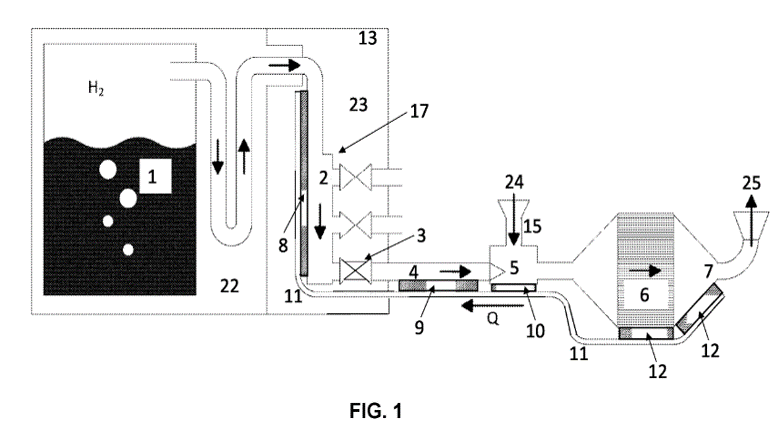
- In accordance with one or more embodiments, the liquid hydrogen store comprises a heat transport line 11, which is formed by a solid-body heat bridge, and/or is formed by a heat pipe through which a working medium flows. The heat transport line 11 extends from the internal section 2 of the discharge line 2, 4 as far as the exhaust line 7. The heat transport line 11 could, according to requirement, also be designed to be significantly shorter and also extend only as far as the catalytic converter 6 or only as far as the enclosure of the catalytic converter 6 (not illustrated).
- One or more thermal contact members 12 of the heat transport line 11 is configured in each case with respect to the catalytic converter 6 and/or with respect to the enclosure of the catalytic converter 6 and with respect to the exhaust line 7, that is to say in warm regions where heat is transferred to the heat transport line 11, and, at the other side, with respect to the mixing chamber 5 and/or with respect to the air feed 15, with respect to the external discharge line 4 and with respect to the internal discharge line 2, where heat is released in each case. The direction of the flow of heat Q (arrow) is illustrated in the figure and is in the direction counter to the direction of the outflowing hydrogen H2 (further arrows) or in the direction from warm parts to cold parts of the liquid hydrogen store or of the BMS.
- The one or more thermal contact members 9 at the external section 4 of the discharge line 2, 4 is configured here for example for a greater transfer of heat than the one or more thermal contact members 10 of the heat transport line 11 with respect to the mixing chamber 5.
- The one or more thermal contact members 9 at the external section 4 of the discharge line 2, 4 is also configured here for example for a greater transfer of heat than the one or more thermal contact members 8 of the heat transport line 11 with respect to the internal section 2 of the discharge line 2, 4.
- In accordance with one or more embodiments, it is consequently the case that waste heat from the catalytic converter of the boil-off management system (BMS) of a vehicle operated with liquid hydrogen is fed via solid-body heat conduction and/or heat pipes to the cold regions of the BMS, in particular the H2 feed lines 2, 4 and the mixing chamber 5 and/or the air feed line 15, in order to heat these and thereby avoid ice formation, air liquefaction and an excessively high density of the hydrogen gas upstream of the nozzle.
- [0039] The surface of the catalytic converter 6 and/or the enclosure of the catalytic converter and of the exhaust pipe 7 of the boil-off management system (BMS) is suitably contacted thermally 12, and a part of the waste heat is transported to the cold regions of the BMS via a solid-body heat bridge or a heat-pipe arrangement 11 with a suitable working medium, or multiple different suitable working media. In said cold regions, the heat is fed to the critical components via suitable one or more thermal contact members 8, 9, 10. Said critical components are:
- Firstly: the mixing chamber 5, where, by way of one or more thermal contact members 10 of the surfaces of chamber and air feed line 15, heat is fed thereto and in this way the icing thereof in the case of outside temperatures just above the freezing point of water is to be prevented, but at the same time, through suitable design, excessive heating in the case of high outside temperatures is prevented.
- Secondly: the external line for boil-off hydrogen 4, where relatively constant cryogenic temperatures prevail in the line and external icing of the line and air liquefaction are most critical. At the same time, an excessively high temperature and consequently an excessively low density of the hydrogen gas upstream of the nozzle is to be avoided here, in order to be able to process all the boil-off gas generated. Conversely, a possible greater input of heat, owing to the position of the line, is less problematic here, it therefore being possible for the one or more thermal contact members 9 to be configured for great feeding of heat and also a constant temperature gradient.
- Thirdly: the internal line for boil-off hydrogen 2: Constant cryogenic temperatures (up to at least approximately 30 K) likewise prevail here. Here, icing is less critical, since, due to the cover of the fittings 13, a certain shielding or a certain insulation effect with respect to the surroundings occurs. An excessively great input of heat, particularly also into the surroundings of the one or more thermal contact members 8, must not take place here, since otherwise sensitive components could be damaged.
Commercialized Technology
Energy Storage Systems
At Magna, we are experts when it comes to meeting OEMs’ exact requirements with our high-quality fuel systems for passenger cars and commercial vehicles. Our success is built on decades of experience in the automotive industry, comprehensive vehicle engineering expertise, and the latest production technologies. We never stop developing our processes and materials, and this commitment to constant innovation helps us translate our competitive edge into real benefits for our customers.
Alternative Energy Storage Systems: Innovating for the Future of Mobility: Our innovation strategy is focused on customer requirements and brand-defining features. Our extensive project management experience, our company values, and our commitment to flexibility are all reflected in our innovative portfolio. We are focused on initiatives designed to make individual mobility more environmentally friendly, and specialize in projects that use fossil fuels as efficiently as possible, thus reducing overall fuel consumption.
Hydrogen Storage Systems: All over the world, emissions regulations are becoming ever more stringent. Truck manufacturers are being forced to come up with solutions, including by delivering alternative propulsion systems. Hydrogen has the potential to complement fossil fuels in the future and, ultimately, to replace them entirely. Magna is playing a significant role in developing and manufacturing hydrogen storage systems for trucks. Our experts in Compressed Hydrogen Storage Systems (CHSS) and Liquid Hydrogen Storage Systems (LHSS) are preparing for whatever the future brings.
Integrating Fuel Cell Systems: Covering the transition to zero emission solutions the propulsion function team of the Engineering Center Steyr has focused its strengths on the functional integration of fuel cell and hydrogen storage systems. In comparison of pure battery electric vehicles, fuel cell electric vehicles offer advantages in range and refuelling solutions especially for heavy duty and non-road applications.
We offer our customers tailor-made solutions from the concept development up to prototyping and testing while considering all necessary safety requirements.
Our Fields of Work: Functional integration of fuel cell and hydrogen storage systems
- Concept development
- Refuelling procedure
- Thermalmanagement
- Safety concept
- Prototyping und testing
About Effectual Services
Effectual Services is an award-winning Intellectual Property (IP) management advisory & consulting firm offering IP intelligence to Fortune 500 companies, law firms, research institutes and universities, and venture capital firms/PE firms, globally. Through research & intelligence we help our clients in taking critical business decisions backed with credible data sources, which in turn helps them achieve their organisational goals, foster innovation and achieve milestones within timelines while optimising costs.
We are one of the largest IP & business intelligence providers, globally serving clients for over a decade now. Our multidisciplinary teams of subject matter experts have deep knowledge of best practices across industries, are adept with benchmarking quality standards and use a combination of human and machine intellect to deliver quality projects. Having a global footprint in over 5 countries helps us to bridge boundaries and work seamlessly across multiple time zones, thus living to the core of our philosophy - Innovation is global, so are we !!!
Related Resources:
Hydrogen Storage Material Made from Magnesium Hydride
Hydrogen Storage/Transport Technology: Overview and Market Insights
Solutions Driving Innovation & Intelligence


Enabling Fortune 500's, R&D Giants, Law firms, Universities, Research institutes & SME's Around The Globe Gather Intelligence That
Protects and Nurtures Innovation Through a Team of 250+ Techno Legal Professionals.