
Articles
Porous Transport Layer (PTL) in Water Electrolysis Cells Part 2
Porous Transport Layer (PTL) in Water Electrolysis Cells Part 2
Introduction on Porous Transport Layer
Water electrolysis is the process whereby water is split into hydrogen and oxygen through the application of electrical energy. The hydrogen thus produced is used as renewable source of energy.
An electrolysis cell is used for this purpose. The three types of electrolyzers are:
- Acidic (PEM: Polymer Electrolyte Membrane);
- Alkaline (AEL); and
- Solid oxide (SOEC) electrolyzer cells.
Porous transport layers (PTLs) play an important role in water electrolysis cells. It is both a conduit for current distribution and mass transport. The PTL facilitates water and gas transport, as well as thermal and electrical conduction, and is required to sustain good contact with adjacent components, i.e., catalyst layer and bipolar plates.
The Porous Transport Layer has the following properties:
Porosity Surface Morphology
Pore Size Wettability
Pore Size Distribution Composition
Porosity Distribution Thickness
Changes in these properties have an effect on the performance of the electrolyzer.
The PTL may be in form of mesh, felts, sintered particles, aerosols or foams.
What are the growth and challenges related to Porous Transport Layer?
- There is a need to reduce PGM (Platinum Group Metals) levels. These metals are costly and lead to a higher CAPEX.
- Challenges are also related to development of Porous Transfer Layers with increased efficiency. This includes optimizing electrical connection with catalyst and improving mechanical support of membrane.
- Because the PTLs are made of metallic components, there is need to develop materials and coatings that have an increased corrosion resistance, which will further enhance the durability of the PTL.
- Also, PTL are majorly used in PEM type electrolyzers. PTLs for other types such as Anion Exchange Membrane need to be developed. In this case, wide development effort has to be made.
Relevant Patent Reference as Example
US20210164109A1
- Title: Method for producing a porous transport layer for an electrochemical cell
- Filed: January 25, 2021
- Published: June 3, 2021
- Assignee: Hoeller Electrolyzer GmbH
- Inventor: Stefan Höller
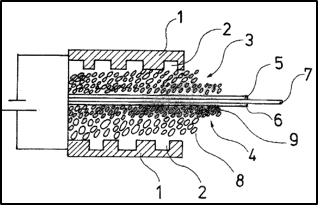
Patent reference ‘109A1 discloses a method for manufacturing a porous transport layer for an electrochemical cell, the method comprising: mixing a metal, which is to form part of the transport layer, as a metal powder with a binder and subsequently shaping out the mixture into an extensive element or depositing the mixture onto a carrier foil as an extensive element; bringing the extensive element to bear on a porous metal layer or on a green part or brown part of a porous metal layer; removing the binder and/or the carrier foil to provide a remaining brown part layer; and sintering the remaining brown part layer diffusion welding the remaining brown part layer to connect the remaining brown part layer to the porous metal layer or to the brown part of the porous metal layer.
CN113437322A
- Title: Porous transmission layer, preparation method thereof and proton exchange membrane water electrolysis device
- Filed: July 2,2021
- Published: September 24,2021
- Assignee: University South Science & Technology China
- Inventor: Deng Tong, Xu Shaoyi, Li Hui
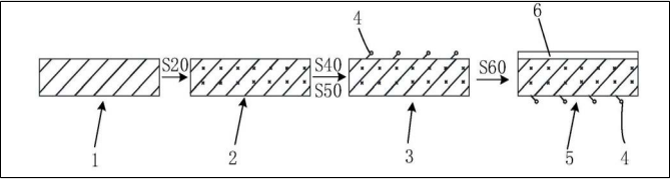
Reference ‘322A discloses a manufacturing method of a porous transmission layer and a proton exchange membrane water electrolysis device. The preparation method of the porous transmission layer comprises the following steps of soaking a carbon felt in a mixed solution, drying the carbon felt, and detecting to ensure that the micropore diameter of the soaked and dried carbon felt is within a preset pore diameter range; sequentially performing carbonization and activation treatment on the dried carbon felt so as to absorb an oxygen-containing functional group on the surface of the activated carbon felt; soaking the activated carbon felt in a water repellent agent solution, and drying to obtain a hydrophobic carbon felt; and coating the surface of the hydrophobic carbon felt with carbon paste so as to form a microporous layer on the surface of the carbon felt. The porous transmission layer produced by the method is uniform in aperture, has hydrophilic and hydrophobic properties, is high in electrochemical activity, is small in contact resistance between the porous transmission layer and a catalytic layer, and very well meets the performance requirements of the proton exchange membrane water electrolysis device.
Read Also: Porous Transport Layer (PTL) in Water Electrolysis Cells Part 1
Relevant Scientific Literature Reference as Example
Literature Reference
Title: Porous Transport Layers for Proton Exchange Membrane Electrolysis Under Extreme Conditions of Current Density, Temperature, and Pressure
Published: 2021
Affiliation: Electrochemical Energy Technology German Aerospace Center (DLR), GKN Sinter Metals Filters GmbH, Westfälische Hochschule University of Applied Sciences, University of Toronto, University of Stuttgart.
Authors: Svenja Stiber, Harald Balzer, Astrid Wierhake, Florian Josef Wirkert, Jeffrey Roth, Ulrich Rost, Michael Brodmann, Jason Keonhag Lee, Aimy Bazylak, Wendelin Waiblinger, Aldo Sau Gago, and Kaspar Andreas Friedric
The PSL/mesh-PTL presented in this work will be now a commercial product and possible interested laboratories can order it from GKN Sinter Metals
This reference discloses a porous transport layer for PEMWE, that enables operation at up to 6 A cm−2, 90 °C, and 90 bar H2 output pressure. It consists of a Ti porous sintered layer (PSL) on a low-cost Ti mesh (PSL/mesh-PTL) by diffusion bonding.
This novel approach does not require a flow field in the bipolar plate. When using the mesh-PTL without PSL, the cell potential increases significantly due to mass transport losses reaching ca. 2.5 V at 2 A cm−2 and 90 °C.
On the other hand, the PEMWE with the PSL/mesh-PTL has the same cell potential but at 6 A cm−2, thus increasing substantially the operation range of the electrolyzer. Extensive physical characterization and pore network simulation demonstrate that the PSL/mesh-PTL leads to efficient gas/water management in the PEMWE.
novel hydrogen liquefaction cycle with a capacity of 369 tons per day has been proposed. The process integration and appropriate design can reduce the power consumption of the light gas liquefaction cycle, wasted cold energy of a natural gas regasification system is integrated into the pre-cooling part of the liquid hydrogen production.
In this study, after being evaporated in the pre-cooling part of the hydrogen liquefaction cycle, the liquefied natural gas (LNG) enters the steam methane reforming (SMR) to feed the hydrogen liquefaction process by hydrogen gas. The mixed refrigerant method is implemented in the proposed model. The specific energy consumption (SEC) of the proposed process is 19.90% less than that of the similar cycles mentioned in the literature. The economic analysis results illustrate that the total annual cost of the proposed model is 13.43% less than that of the base model.
Test and Results
Developed a novel PTL for PEMWE by sintering a macro-porous structure of Ti on an expanded Ti mesh, PSL/ mesh-PTL, thus producing a fully functional cell component with enhanced properties. The PSL has uniform pore size distribution and porosity and is fully bonded via diffusion to the mesh-PTL, which eliminates any interfaces that cause ohmic losses.
From the PEMWE tests, the PSL/mesh-PTL allows achieving up to 6 A cm−2, 90 °C, and 90 bar H2 output operation. The PEMWE with the PSL/mesh-PTL reached 31% higher efficiency than the mesh-PTL at a nominal load of 4 A cm−2.
Pore network modeling showed that the large increase in performance is attributed to the high permeability for both liquid and gas for the PSL/ mesh-PTL, providing effective two-phase transport at high current densities. The PSL/mesh-PTL design addresses all tasks in the cell regarding water distribution and gas transport, thereby eliminating the need for a bipolar plate with a complex flow field. Operating PEMWE at high current density, temperature, and pressure makes it more economically attractive.
Future Aspect
In the near future, these challenging operating conditions can be established as the new SoA in electrolysis for the large-scale integration of renewable energies, thus reductions in CO2 emissions can continue at a more aggressive pace.
About Effectual Services
Effectual Services is an award-winning Intellectual Property (IP) management advisory & consulting firm offering IP intelligence to Fortune 500 companies, law firms, research institutes and universities, and venture capital firms/PE firms, globally. Through research & intelligence we help our clients in taking critical business decisions backed with credible data sources, which in turn helps them achieve their organisational goals, foster innovation and achieve milestones within timelines while optimising costs.
We are one of the largest IP & business intelligence providers, globally serving clients for over a decade now. Our multidisciplinary teams of subject matter experts have deep knowledge of best practices across industries, are adept with benchmarking quality standards and use a combination of human and machine intellect to deliver quality projects. Having a global footprint in over 5 countries helps us to bridge boundaries and work seamlessly across multiple time zones, thus living to the core of our philosophy - Innovation is global, so are we !!!
Solutions Driving Innovation & Intelligence


Enabling Fortune 500's, R&D Giants, Law firms, Universities, Research institutes & SME's Around The Globe Gather Intelligence That
Protects and Nurtures Innovation Through a Team of 250+ Techno Legal Professionals.