
Articles
EV Charging Optimization - Fast Charging: Factors & Methods
EV Charging Optimization - Fast Charging: Factors & Methods
Factors Affecting Charging Speed
There are a lot of variables that affect each vehicle’s charging speed. When a battery is more depleted, the charging speed is typically faster. However, batteries don’t like to charge quickly when they’re too hot or too cold, so charging may be slower in extreme temperatures. Different vehicle manufacturers design different batteries. And because the battery is usually the single most expensive “thing” inside a vehicle, it’s in everyone’s best interest to maximize the battery’s longevity, health, and safety.
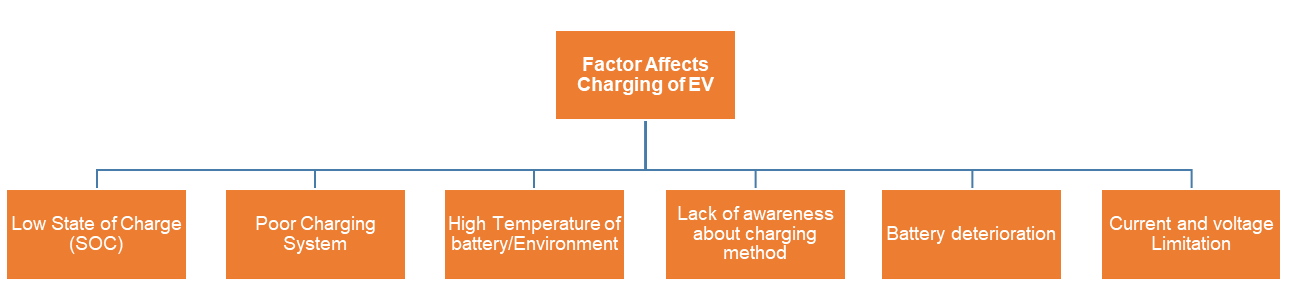
- Battery charge fastest when they are nearly empty (Low SOC)
- Several different technologies can charge EVs faster, including direct current (DC) fast charging, which can charge an EV to 80% in as little as 30 minutes.
- Battery do not like to too hot or too cold. In extreme weather (hot or cold), your charge rate will be slower.
- If you use other load during charging, such as the cabin air conditioning, heating, lights or radio. It will take more time to fill your battery.
- Battery can deteriorate over time and lose capacity.
- Imagine electricity as water flowing through a pipe. The amount of Power (k\W) you receive is the product of Voltage (V) and Current (A). Both your vehicle and the charger have voltage and current limits. When you plug in (let's say to a 100kW charger), the charger matches your EV battery voltage and delivers current. This current is limited by either the charger or the vehicle (whichever is lower). If your EV battery has a voltage limit below 500V (let's say 380V), the charger may deliver less than the maximum power available because the charger reached the maximum current limit (of 200A). In this instance, the charger delivers 76k\W.
Various Methods of Charging
Trickle Charge
The slowest method of charging your EV at home, using a standard (three-prong) 220V plug. It is only recommended in urgent cases, with caution and consultation with electricity providers.
Provides charging through a standard (three-prong) 220V plug that comes with your EV. The other end is simply plugged directly into your EV
AC Charge
The most common and recommendable home charging option
Provides charging through a 230V outlet which allows charging 3 to 4 times faster than Trickle Charge – depending on the acceptance rate of your specific model and the charger
DC Fast Charging
The fastest way to charge your EV – at a public DC Fast charging station with power from 50kW and above. With this method you can top up your battery from 20 to 80% in approx. 40 minutes. There are also some ultra-fast charging stations that already provide more than 150kW.
Read Also: EV Charging Optimization Overview
Methods to Reduce Charging Time
Using Faster-Charging Technologies
Several different technologies can charge EVs faster, including direct current (DC) fast charging, which can charge an EV to 80% in as little as 30 minutes.
- Determining State of Charge
- Interleaved Buck Converter
- Electromagnet
- Pulse Charging
- Mechanical Changes (Port Changes)
- Charging Control
- DC-DC Converter
Increasing the Charging Power
Another way to reduce charging time is to increase the power of the charging station. Higher-power charging stations can deliver more electricity to the vehicle’s battery quickly.
- Detecting Current Leakage
- Determining State of Charge
- Cable Modifications
- Constant Current Constant Voltage Charging
- Power Sharing Between Chargers
- Cable/Charging Plug Cooling
Using Multiple Charging Ports
Some EVs have multiple charging ports, which can simultaneously charge the vehicle’s battery. It can reduce the overall charging time.
- CHAdeMO
- CCS
- AC-DC Port
- AC-AC Port
- DC-DC Port
Optimizing Charging Times
Charging an EV when there is less electricity demand can also help reduce charging time. For example, charging an EV overnight when electricity demand is generally lower can be more efficient than charging during the day.
- Pick hours
- Over night Charging
- SOC
Improving Battery Technology
Developing more advanced battery technology can also help to reduce charging time.
- Rechargeable Energy Storage Systems
- Multi Layered Division Battery
- Battery Cooling
- Chemistry Modifications
Fast Charging Technology
COMBINED CHARGING SYSTEM (CCS)
The Combined Charging System (CCS) is based on open and universal standards for electric vehicles. The CCS combines single-phase AC, three-phase AC and DC high-speed charging in both Europe and the US – all in a single, easy to use system.
The CCS includes the connector and inlet combination as well as all the control functions. It also manages communications between the electric vehicle and the infrastructure. As a result, it provides a solution to all charging requirements.
CHAdeMO
CHAdeMO is a DC charging standard for electric vehicles. It enables seamless communication between the car and the charger.
It is developed by CHAdeMO Association, which is also tasked with certification, ensuring compatibility between the car and the charger.
The Association is open to every organization that works for the realization of electro mobility.
Supercharger
Tesla has installed their own proprietary chargers throughout the country (and the world) to provide long distance driving capability to Tesla vehicles.
They are also placing chargers in urban areas that are available for drivers through their daily lives.
Tesla is currently has over 1,600 Supercharger stations across North America
About Effectual Services
Effectual Services is an award-winning Intellectual Property (IP) management advisory & consulting firm offering IP intelligence to Fortune 500 companies, law firms, research institutes and universities, and venture capital firms/PE firms, globally. Through research & intelligence we help our clients in taking critical business decisions backed with credible data sources, which in turn helps them achieve their organisational goals, foster innovation and achieve milestones within timelines while optimising costs.
We are one of the largest IP & business intelligence providers, globally serving clients for over a decade now. Our multidisciplinary teams of subject matter experts have deep knowledge of best practices across industries, are adept with benchmarking quality standards and use a combination of human and machine intellect to deliver quality projects. Having a global footprint in over 5 countries helps us to bridge boundaries and work seamlessly across multiple time zones, thus living to the core of our philosophy - Innovation is global, so are we !!!
Solutions Driving Innovation & Intelligence


Enabling Fortune 500's, R&D Giants, Law firms, Universities, Research institutes & SME's Around The Globe Gather Intelligence That
Protects and Nurtures Innovation Through a Team of 250+ Techno Legal Professionals.