
Articles
EV Charging Optimization - Industry Leaders Driving Fast Charging
EV Charging Optimization - Industry Leaders Driving Fast Charging
ABB – Fast Charging
The solution to the problem is developed by ABB
Technology Summary
ABB Supports CCS, CHAdeMO, and AC charging standard.
In another preferred implementation the EVSE is configured for charging the electrical vehicle by using a Combined Charge System, CCS, protocol according to IEC 61851-23 and/or SAE J1772 standard and/or whereby the charging connector and/or the charging cable are provided according to IEC 62196 standard. The Combined Charging System, CCS, protocol is a fast charging method for charging electric vehicles delivering high-voltage direct current via a charging connector derived from SAE J1772 standard (IEC Type 1) or IEC Type 2 connector.
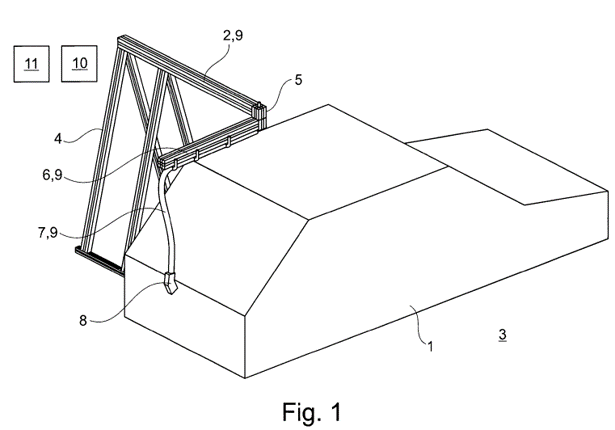
For receiving electrical energy to charge the electrical vehicle 1 with a respective DC current, the charging arrangement is connected to an electric vehicle charge equipment, EVSE, 10. The EVSE 10 is connected via a transformer and a converter to an AC grid 11. The EVSE 10 is configured for charging the electrical vehicle 1 by using a Combined Charge System, CCS, protocol according to IEC 61851-23 and/or SAE J1772 standard, thereby allowing said charging currents of 500A DC or more at 1000V DC or more. In an equal manner the charging connector 8 and the charging cable 7 are provided according to IEC 62196 standard.
Product Information - Terra 360 (Fast Charger)
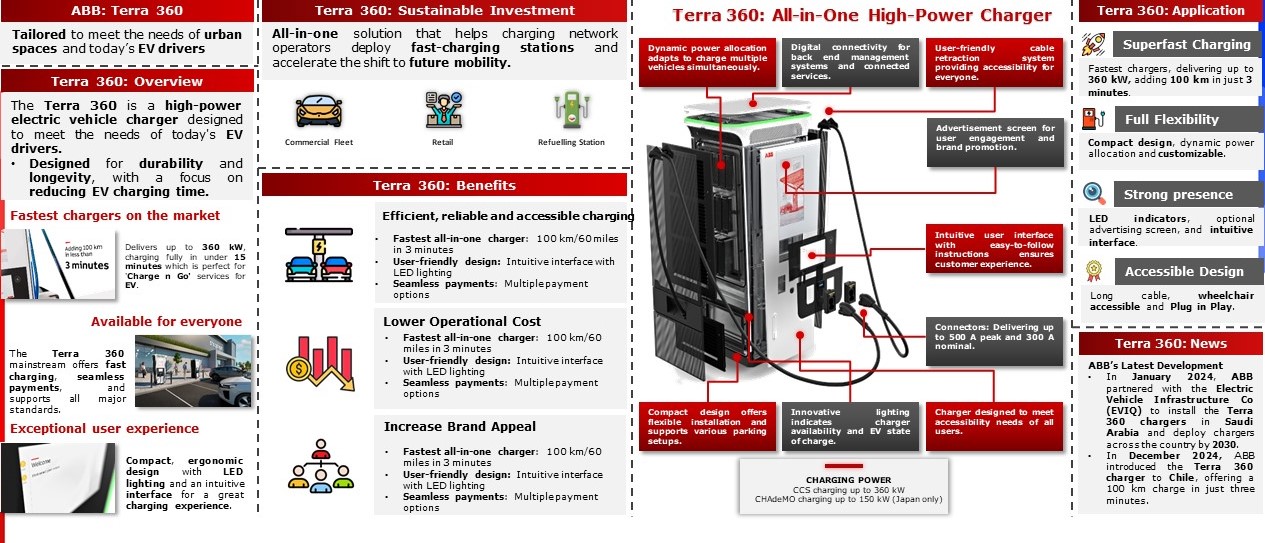
The Terra 360 is our most powerful all-in-one charger, offering fast, safe, and user-friendly charging tailored for today's EV drivers.
Company Information
ABB Ability™ connected chargers enable fast global service and pro-active maintenance. ABB has years of experience in creating, installing and maintaining charging infrastructure, including several nationwide charger networks.
Highlights
- Key people: Morten Wierod CEO
- Foundation Year: 1883
- Industry: Energy
- Location: HQ Zurich – Switzerland
- No. of Employees: 105,000+ employees
- Revenue: $32 billion
- Type of organization: Swedish-Swiss Multinational Electrical Engineering Corporation
- Website: www.abb.com
Technology Information
ABB lays the foundations for a future of smarter, reliable, and emission-free mobility, accessible by everyone, everywhere. ABB offers a total EV charging solution from compact, high quality AC wallboxes, reliable DC fast charging stations with robust connectivity, to innovative on-demand electric bus charging systems.
ABB has launched Terra 360 – the world’s fastest car charger capable of fully charging an electric car in less than 15 minutes, that’s 100km of range in less than 3 minutes. It is also the only charger designed specifically to charge up to 4 vehicles at once.
As a global market leader in charging solutions for EVs ABB recently introduced a first solution that enables EV drivers to feed excess energy back to the grid operator. This bidirectional technology, called Vehicle-to-Grid (V2G) is currently available via utilities and big fleet operators and enables the influx of excess energy to act like a buffer and stabilize the power grid in specific projects.
Recent News
ABB announced that its E-mobility division has agreed to acquire a controlling stake in Numocity, a leading digital platform for electric vehicle charging in India. ABB will increase its shareholding to a controlling majority of 72 percent and has the right to become sole owner by 2026.
ABB has invested $10 million in San Francisco-based ECOtality, a clean electric transportation and storage technologies company, to enter North America’s electric vehicle (EV) charging market and provide ECOtality with a strong global ally in power delivery systems.
Increasing the Charging Power
- Another way to reduce charging time is to increase the power of the charging station. Higher-power charging stations can deliver more electricity to the vehicle’s battery quickly.
- Modification in Charging infrastructure
Method to Increase Charging Power
The third generation of Terra HP charge post is a modular 175-350 kW high-power charger ideally suited for highway corridor and EV fleet operations.
The Terra HP generation III charge post offers a premium charging experience with high-output power at low noise levels.
Read Also: EV Charging Optimization Overview
Toyota – Detect Current Leakage
The solution to the problem is developed by Toyota Motor
CN102164771B Publication Year: 2014, Assignee: Toyota Motor
Technology Summary
The object of the invention is in the charge control method of elec. vehicle and elec. vehicle, during possessing the elec. vehicle of battery, charger, the charger control part that charger is controlled that can charge from external power supply and the battery control part that the state of battery is monitored, degradation of energy while reducing charging, improves charge efficiency.
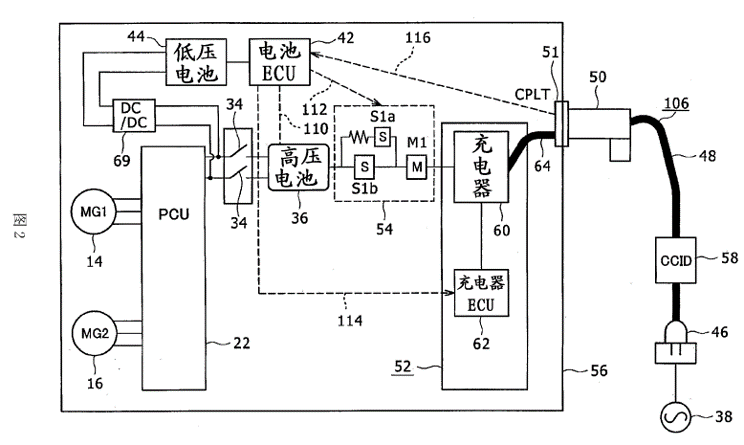
As shown in Figure 2, when the charging entrance 51 with being arranged at car body 56 is connected, charge connector 50 is connected with external power supply 38 with plug 46 via the high-pressure system cable 48 of deriving from car body 56 to outside. At this, charging entrance 51 is for the external power supply 38 from outside vehicle, to accept the electricity interface of charging power. In addition, charge connector 50 is exported the CPLT as voltage signal to battery ECU42 in the situation that being connected with external power supply 38. At this, CPLT is by CCID (Charging Circuit Interrupt Device, charge circuit interrupt unit) the 58 CPLT generating units that have, for example control the voltage signal that steering circuit (not illustrating) generates, via charge connector 50, be output to battery ECU42, be imported into the I/O of battery ECU42, thus, to the I/O of battery ECU42, apply voltage, comprise that the battery ECU42 of switch connecting charger ECU start unit 70 (Fig. 4) starts. CCID58 also has detection of electrical leakage unit.
Citation Tree

Using Multiple Charging Ports
The concept of a multiport, flexible and intelligent Electric Vehicle (EV) DC-type charger which features multiple output charging spots through the implementation of multiplexing techniques will be developed.
As multiple EVs are connected to a single charging unit, the maximization of the utilization of power installed can be achieved. Output power and voltage scalability is a key feature of the system by usage of Power Electronics Building Blocks (PEBB), i.e. the total power can be scalable to several MW. This leads to manufacturing cost advantages (or low investment of €/kW) because a single circuit building block design can satisfy a plurality of business applications and many charging standards (conventional and new - CCS and CHAdeMO). More importantly, the system can be adapted to allow higher battery voltages, e.g. up to 1 kV, following the trend of the EV market.
Additionally, to counter act to the expected reduction of governmental subsidies and consequent increment of the charging cost, the system can incorporate energy storage into the charger inner DC-grid. This is advantageous to buffer the power demand from the AC grid and to reduce energy consumption costs. This also allows the participation in the network ancillary service market generating extra profits for the stakeholders. All in all, the technical advantages of the propose charging concept allows reduction of the cost of charging EVs. The study verifying the advantages and requirements for the energy storage integration will be shared between TUD and ALFEN.
Volkswagen – Multiple Charging Socket/Port
The solution to the problem is developed by Volkswagen
Technology Summary
An adapter having a CHAdeMO socket on its input side for receiving a charging station connector of a CHAdeMO charging station, a CCS connector on its output side for connection to an electric vehicle, and an electronic circuit logic which embeds signal states entering via the CHAdeMO socket into a CAN message and to provide them as an output signal.
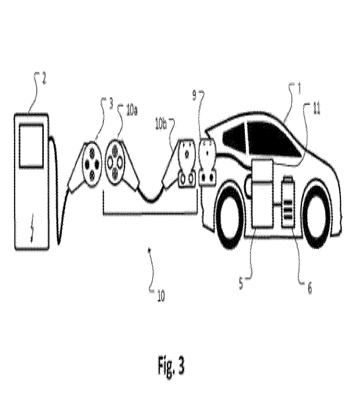
FIG. 3 shows a charging technique according to an exemplary embodiment. An electric vehicle 1 is connected with a CCS charging interface (CCS socket 9) and an additional controller 11 using a CHAdeMO-CCS adapter 10 to a CHAdeMO charging station 2. The CHAdeMO-CCS adapter 10 comprises a CHAdeMO socket 10 a into which the CHAdeMO connector 3 of the charging station 2 is inserted, and a CCS connector 10 b which is inserted into the CCS socket 9 of the electric vehicle 1. In the adapter 10, the digital control signals are converted into CAN messages which are converted again into electrical signals by the additional controller 11 in the electric vehicle 1 and provided to the connected charging manager 5. The digital output signals of the charging manager 5 also experience a conversion into CAN messages which are sent by the additional controller 11 in the electric vehicle 1 to the other side in the CHAdeMO-CCS adapter 10. The CAN messages necessary for communication during the charging process from the charging station 2 and from the charging manager 5 of the electric vehicle 1, respectively, are forwarded both from the logic in the CHAdeMO-CCS adapter 10 and in the additional controller 11 of the electric vehicle 1 unchanged to the respective end station.
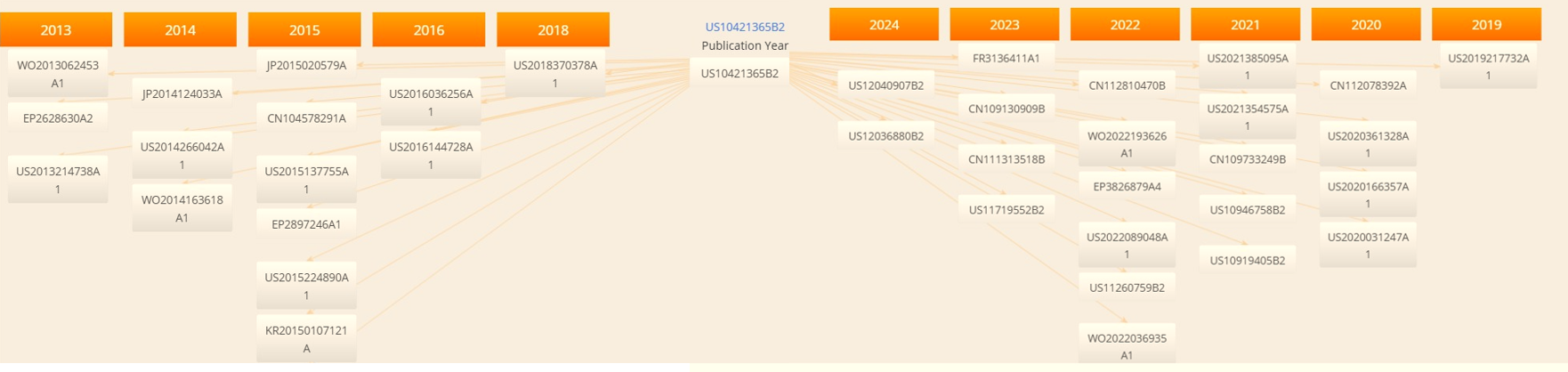
Citation Tree
Optimizing Charging Times
With a Level 1 charger, which you can just plug into a regular 120 volt electrical outlet in your home, it will likely take you several hours to fully charge your vehicle.
A Level 2 charger – which makes up the majority of public chargers – will probably take just a few hours to charge your battery.
Meanwhile, a Direct Current Fast Charger (DCFC) will take less than an hour to fully charge your vehicle.
The time it takes to completely charge your battery depends on the capacity of the battery, how full/empty it is when you plug it in, the type of charger you are using, and whether you are using your own personal charger or a public one.
The state of charge (SOC) is a measurement of the amount of energy available in a battery at a specific point in time expressed as a percentage. For example, the SOC reading for a computer might read 95% full or 10% full. The SOC provides the user with information of how much longer the battery can perform before it needs to be charged or replaced. Understanding the state of charge is important because understanding the remaining capacity of a batter can help make a control strategy.
Essentially, the SOC acts like a fuel gauge in a car. It informs the users of how much longer they can operate the device or machine before it runs out of energy and can no longer perform. In fact, SOC readers have replaced the fuel gauge in electric cars. Electronics with batteries utilize various methods to measure the SOC, such as measuring voltage, specific gravity, internal impedance and counting coulombs. Advancements made with artificial intelligence (AI) have also created new ways to estimate the state of charge.
Read Also: EV Charging Optimization - Fast Charging: Factors & Methods
Hyundai Motor – Optimize Charging Ratio
The solution to the problem is developed by Hyundai Motor
Technology Summary
“Smart charging”: A system in which EVSE and/or PEV communicate with power grid in order to optimize charging ratio or discharging ratio of EV by reflecting capacity of the power grid or expense of use.
The embodiments of the present disclosure apply different charging modes in consideration of whether a driver (or, a passenger) is present in a vehicle, whether an IMD is present in a vehicle, and the like. Thus, as compared with the conventional charging technique of performing WPT at a constant charging power, it is possible to achieve a target state of charge (SOC) more efficiently and quickly, and time required for EV charging can be reduced.
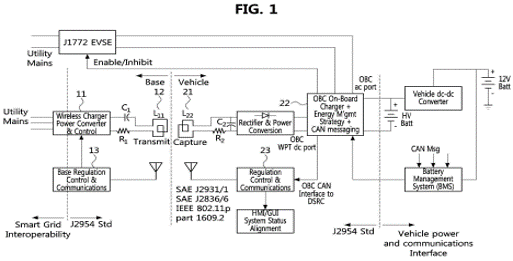
According to the SAE TIR J2954, referring to FIG. 1, a WPT system for an EV (alternatively referred to herein as an “EV WPT system”) may comprise a utility interface, a high frequency power converter, coupled coils, a rectifier, a filter, an optional regulator, and communication devices between a vehicle energy charge/store system and the power converter connected to the utility. The utility interface may be similar to a traditional EVSE connection for single-phase or three-phase AC power.
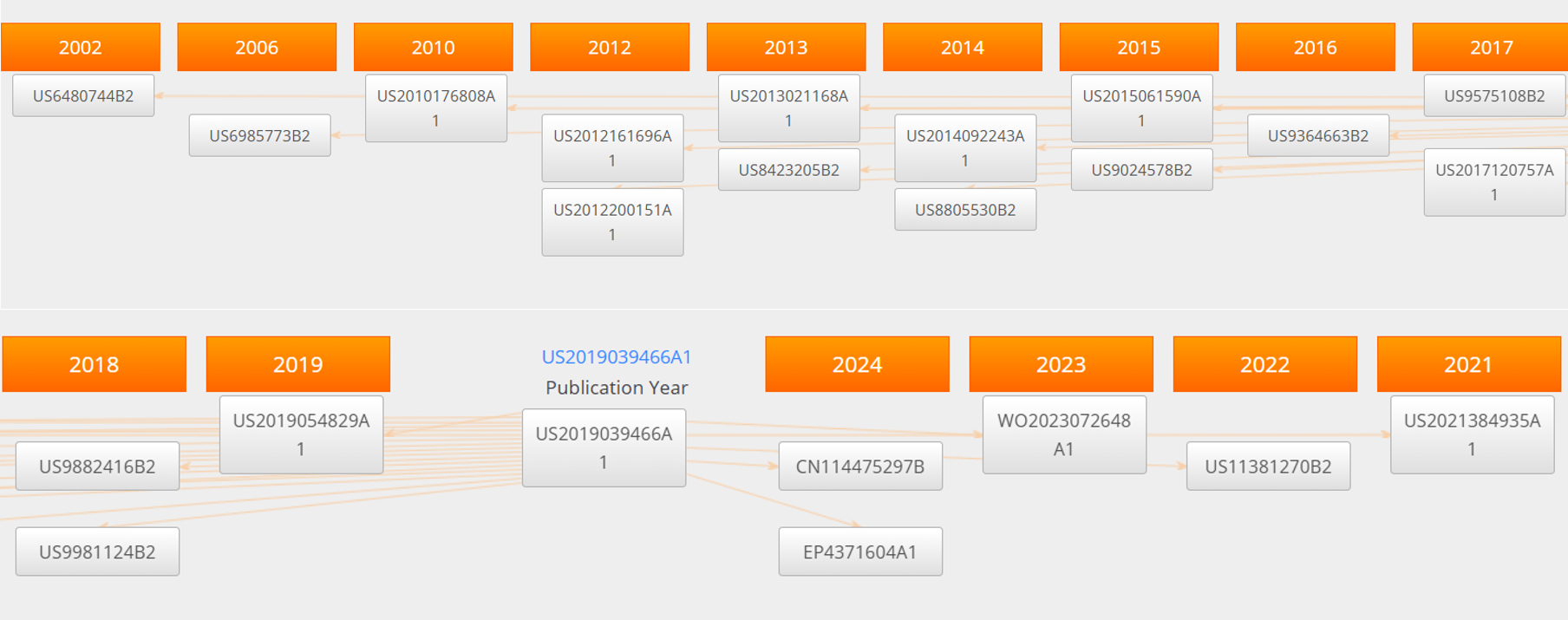
Citation Tree
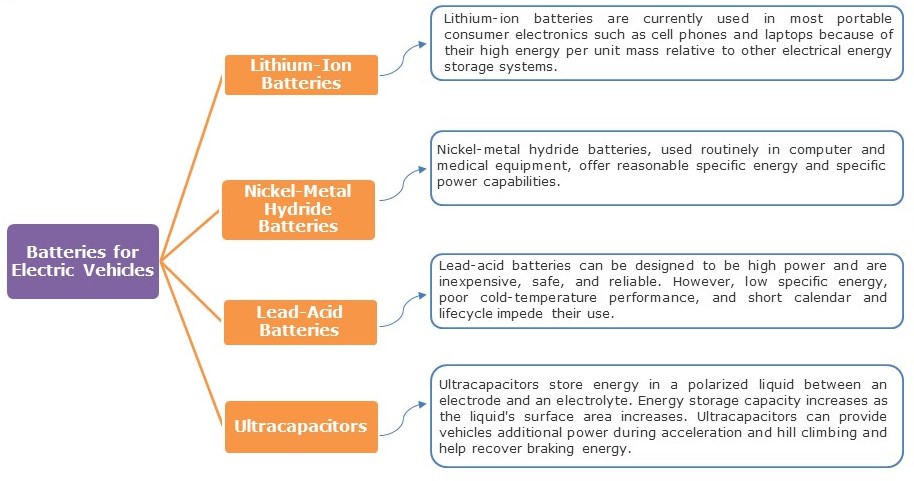
Improving Battery Technology
Ford Global – Improving Battery Technology
The solution to the problem is developed by Ford Global
US10286807B2 Publication Year: 2019, Assignee: Ford Global
Technology Summary
According to embodiments of the present disclosure, a vehicle is provided. The vehicle includes a traction battery, a battery cooling system configured to cool the traction battery, and a controller configured to request activation of the battery cooling system to cool the traction battery prior to arrival at a DCFC station in response to a signal indicating an expected DCFC event, and configured to inhibit the activation in response to an expected duration of the expected DCFC event being less than a predefined duration. The expected DCFC event may be indicated based on aggregate GPS data, navigation data, or defined by the state of charge of the battery being less than a threshold. The predefined duration of the expected DCFC event based on a temperature of the traction battery, state of charge of the traction battery, ambient temperature, or cabin climate.
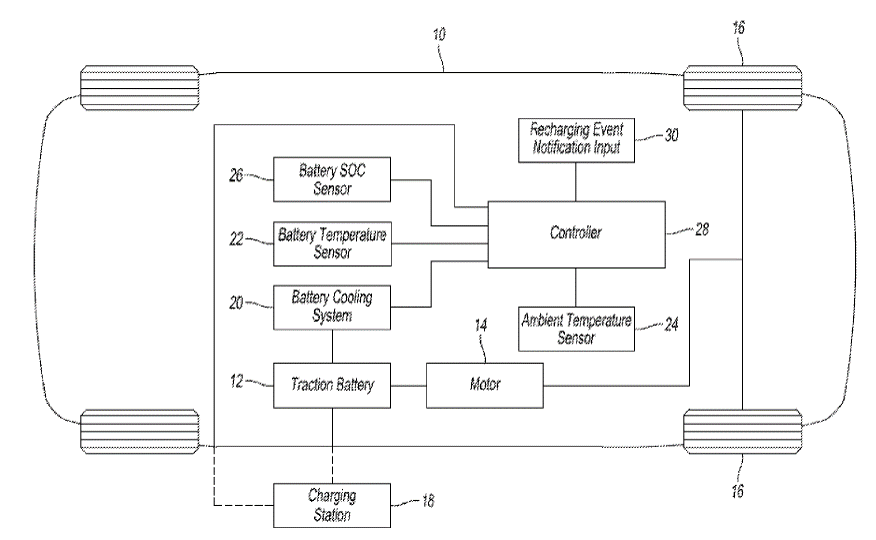
As such, the controller 28 may also be configured to determine whether or not preemptive cooling is needed. Specifically, whether the fast charge process will be completed in duration of time less than a predefined duration. Sensors for ambient temperature, temperature of the traction battery, cabin climate, and/or SOC of the traction battery are inputs for determining whether the DCFC will take longer than a predefined duration of time. If so, the request from controller 28 to activate the battery cooling system 20, for preemptively cooling the traction battery, is not inhibited. If the predefined duration of time is not exceeded, the controller 28 will inhibit the battery cooling system 20 from preemptively cooling, even when a DCFC event is expected. DUC information and other similar conditions can also be used as inputs for determining whether preemptive cooling is needed.
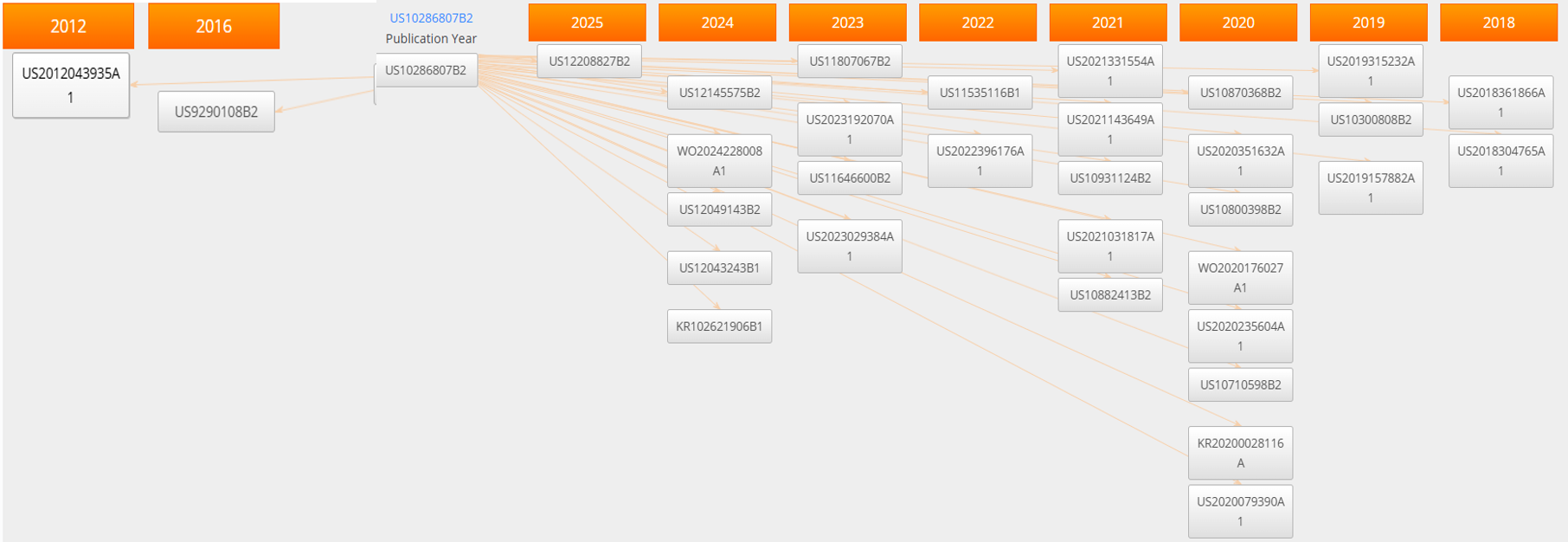
Citation Tree
Recent Development in Electric Vehicle Charging
The automotive industry is undergoing one of the most dramatic transformations in its history. A key element of this transformation is the move towards electric vehicle (EV) technology.
Solutions such as cloud-based battery management systems allow EVs to be more efficient while reducing the need for costly onsite maintenance visits, resulting in lower operational costs over time. Additionally, these advances will enable faster charging times, leading to improved convenience for drivers while reducing emissions associated with long waiting periods at charging stations.
Tesla Supercharging times have reduced by one-third in just five years, the company said, as its efforts to alleviate false narratives related to elongated charging sessions have improved thanks to technological advancements.
Solid-state batteries will offer an improvement in safety, power output, energy density, and cost-efficiency compared to traditional lithium-ion batteries. They will be a major factor in the expansion of the electric car market and the increase in popularity of electric cars. Solid-state batteries will take recharging to the next level. They are capable of a faster rate of charge and as a result, EVs will be recharged in less than 10 minutes, like stopping at a gas pump. This improved charging speed will lead to more convenience on longer trips. With long ranges and quick charging, EVs will travel long distances like ICEs.
Batteries are becoming increasingly efficient, allowing for longer ranges and faster charging times. In addition, new materials such as graphene are making batteries lighter and more powerful than ever before.
EV charging software companies provide software solutions that optimize electric vehicle charging operations (charging station management or energy management and so payments and billing).
- The global electric vehicle (EV) charging revenue is likely to exceed $300 billion by 2027, up from $66 billion in 2023.
- According to Juniper Research, the total number of plug-in vehicles will surpass 137 million globally by 2027, up from 49 million in 2023.
- The leading global EV charging vendors currently are Siemens, ChargePoint and ABB.
- We are finally starting to get a little more information about the specs of the Supercharger V4, the latest generation of Tesla’s popular DC fast-charging station.
- A Tesla owner spotted the electric car specs of the charger, revealing a rated voltage of 1,000V and a rated current of 615A.
- That would mean a total max power output of 600 kW. Of course, the top rated output is rarely something that is maintained or even achieved, but theoretically, that’s what the new Supercharger V4 can do.
- The other limitation is at the car level. Most Tesla vehicles today won’t be able to accept half of that power, and that’s when they are almost entirely depleted. It could indicate where Tesla plans to go with its electric vehicles in the near future.
- Also, we don’t know if Tesla splits that power – though that strategy is something that the automaker previously moved away from with the Supercharger v3.
- Volkswagen introduces ID 2all affordable EV concept with nearly 300 miles range
- VW’s affordable EV will be based on its new modular electric drive (MEB) platform, dubbed the MEB Entry Platform, and will be the first vehicle with front-wheel drive based on it.
- Initial plans called for Volkswagen’s ID. LIFE concept to be the first affordable EV based on the new platform designed for the smaller car segment, but those plans have seemingly been tossed to the side.
- Volkswagen says its new electric car can be charged to 80% in less than 20 minutes, although specifics are not mentioned.
The new Hawaii EV station is in Pearl City, on the island of Oahu. It features four EV chargers that can deliver up to 150kW. As is the case with all other Electrify America charging stations, drivers in Hawaii can pay by credit or debit card or by using the Electrify America mobile app.
- Lucid has since introduced a Performance version of the Grand Touring, as well as a freaky fast tri-motor Air called Sapphire. I’m admittedly frothing at the mouth to experience the 2.6 second 0-60 mph the Sapphire is touting, but recently I had to “settle” for the Touring. Poor me.
Future Scope
Charging infrastructure is increasingly being integrated with renewable energy and battery storage systems. In 2025, EVs are poised to offer huge value-added benefits to grid stability, especially when solving for renewable energy intermittency:
- Solar and wind-powered charging sites
- Second-life EV batteries in charging infrastructure
- Vehicle-to-Grid (V2G)
Ultra-fast charging stations, capable of delivering up to 350 kW, will dramatically shorten charging times. With these chargers, EVs can reach 80% charge in just 15-20 minutes, offering practical solutions for long-distance travel and commercial fleet vehicles, enhancing convenience for all users.
By 2025, mobile and web apps will enhance the EV charging experience by providing real-time updates on charger availability, pricing, and maintenance.
The Global Electric Vehicle Charging Infrastructure Market Size accounted for USD 17.2 Billion in 2021 and is projected to achieve a market size of USD 182.9 Billion by 2030 rising at a CAGR of 30.2% from 2022 to 2030.
Wireless charging technology, also known as inductive charging, is another breakthrough that could revolutionize the EV landscape. Unlike traditional charging stations, wireless charging allows vehicles to charge simply by parking over a charging pad.
India will curb its CO2 emissions by one Giga tonne by 2030. This feat will translate into less air pollution in metros and mini metros and will keep the present and future generations healthier.
About Effectual Services
Effectual Services is an award-winning Intellectual Property (IP) management advisory & consulting firm offering IP intelligence to Fortune 500 companies, law firms, research institutes and universities, and venture capital firms/PE firms, globally. Through research & intelligence we help our clients in taking critical business decisions backed with credible data sources, which in turn helps them achieve their organisational goals, foster innovation and achieve milestones within timelines while optimising costs.
We are one of the largest IP & business intelligence providers, globally serving clients for over a decade now. Our multidisciplinary teams of subject matter experts have deep knowledge of best practices across industries, are adept with benchmarking quality standards and use a combination of human and machine intellect to deliver quality projects. Having a global footprint in over 5 countries helps us to bridge boundaries and work seamlessly across multiple time zones, thus living to the core of our philosophy - Innovation is global, so are we !!!
Solutions Driving Innovation & Intelligence


Enabling Fortune 500's, R&D Giants, Law firms, Universities, Research institutes & SME's Around The Globe Gather Intelligence That
Protects and Nurtures Innovation Through a Team of 250+ Techno Legal Professionals.