
Articles
Topology Optimization in Heat Transfer: Heat Exchanger Taxonomy
Topology Optimization in Heat Transfer: Heat Exchanger Taxonomy
Heat Exchanger Taxonomy: A Detailed Guide to Design, Materials, Mechanisms, and Applications
Heat exchangers are fundamental to modern engineering systems, enabling efficient thermal energy transfer across a wide range of industries—from automotive and aerospace to energy and manufacturing. As technologies evolve, so does the complexity and diversity of heat exchanger designs. This article presents a detailed taxonomy t`o help understand how heat exchangers are classified based on geometry, device type, materials, manufacturing methods, heat transfer mechanisms, and performance considerations.
Topology (Shape & Design)
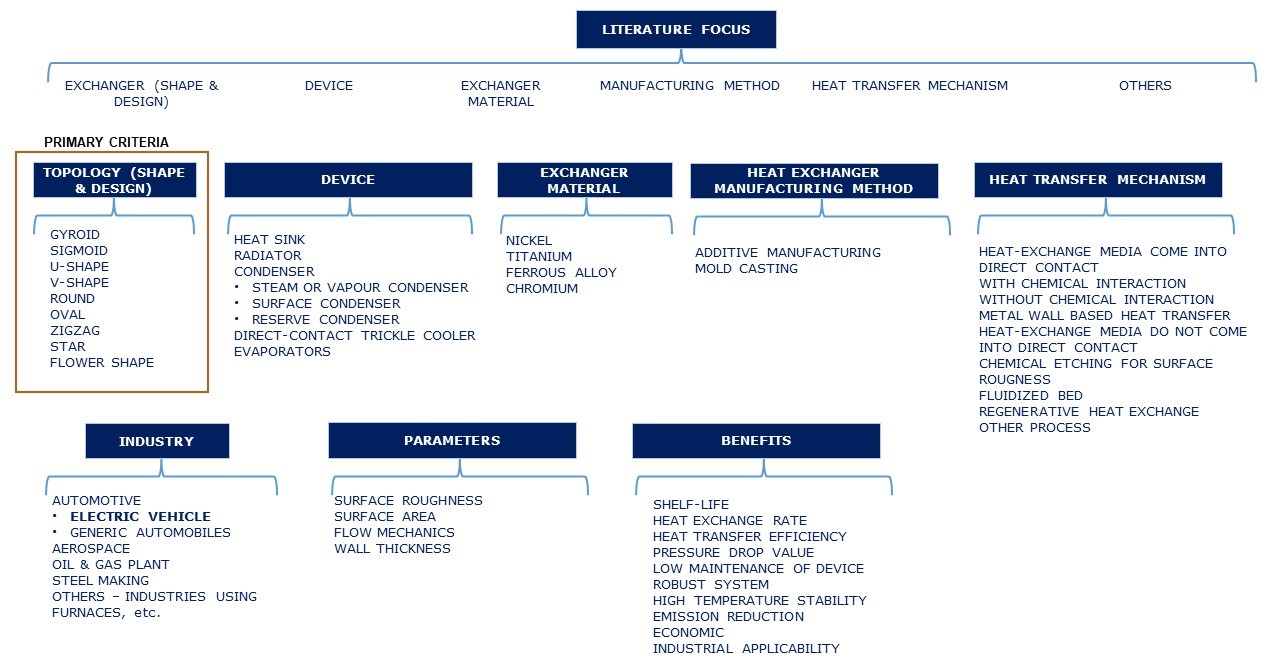
Topology refers to the geometric configuration of a heat exchanger, which plays a critical role in determining heat transfer efficiency, pressure drop, compactness, and manufacturability.
Common Geometries:
- Gyroid Structures: Advanced, triply periodic minimal surface (TPMS) geometries offering high surface area-to-volume ratios. Ideal for compact, high-efficiency systems, especially when produced using additive manufacturing.
- Sigmoid Shapes: Smooth, curved pathways that enhance fluid flow continuity and reduce turbulence- induced losses.
- U-shape & V-shape Designs: Common in tube-based exchangers, allowing thermal expansion management and compact layouts.
- Round & Oval Tubes: Widely used in conventional heat exchangers. Oval shapes often provide better aerodynamic performance and reduced drag in airflow applications.
- Zigzag Channels: Promote turbulence, increasing heat transfer rates but potentially increasing pressure drop.
- Star & Flower Shapes: Specialized geometries designed to maximize surface area and mixing, often used in high-performance or experimental systems.
The choice of topology is a balance between thermal performance, fluid dynamics, and manufacturing feasibility.
Read Also: Topology Optimization in Heat Transfer: Overview
Device Types
Heat exchangers are also categorized by their functional role within a system:
- Heat Sinks: Common in electronics cooling, these devices dissipate heat into the surrounding air, often using fins to increase surface area.
- Radiators: Used in vehicles and industrial systems to transfer heat from fluids to air, typically involving finned tubes.
- Condensers: Convert vapor into liquid by removing latent heat, widely used in power plants and refrigeration systems.
- Steam or Vapour Condensers: Handle phase change from vapor to liquid.
- Surface Condensers: Keep fluids separate while exchanging heat across a surface.
- Desuperheaters: Reduce the temperature of superheated steam to a saturated state, often by injecting cooling water.
- Direct-Contact Trickle Coolers: Allow fluids to come into direct contact, enabling efficient heat transfer through mixing.
- Evaporators: Facilitate the phase change from liquid to vapor, commonly used in refrigeration and chemical processing.
Each device type is tailored to specific thermal processes, whether sensible or latent heat transfer is involved.
Exchanger Materials
Material selection is crucial for ensuring performance, longevity, and safety under operating conditions.
Common Materials:
- Nickel: Offers excellent corrosion resistance and is suitable for high-temperature applications.
- Titanium: Highly resistant to corrosion, especially in seawater and aggressive chemical environments.
- Ferrous Alloys (e.g., Stainless Steel): Provide strength, durability, and moderate corrosion resistance at a relatively lower cost.
- Chromium-based Alloys: Enhance oxidation resistance and are often used in high-temperature environments.
Key Considerations:
- Thermal conductivity
- Corrosion resistance
- Mechanical strength
- Cost and availability
Material choice directly impacts maintenance cycles and operational reliability.
Manufacturing Methods
The method of manufacturing influences design flexibility, cost, and scalability.
- Additive Manufacturing (3D Printing): Enables the creation of highly complex geometries such as gyroid or lattice structures that are impossible with traditional methods. It allows for optimization of internal flow paths and heat transfer surfaces.
- Mold Casting: A conventional technique suitable for producing robust components in large volumes. While less flexible in geometry, it is cost-effective for standard designs.
Emerging hybrid manufacturing approaches are combining the strengths of both methods.
Heat Transfer Mechanisms
Heat exchangers operate through different physical mechanisms depending on the design and application:
- Direct Contact Heat Transfer: Fluids mix directly, allowing rapid energy exchange. This may involve chemical interaction depending on the media.
- Indirect (Surface) Heat Transfer: Fluids remain separated by a solid wall, which conducts heat between them. This is the most common approach.
- Metal Wall-Based Transfer: Heat conduction occurs through metallic barriers, often enhanced with fins or extended surfaces.
- Chemical Etching for Surface Enhancement: Micro-texturing techniques increase surface roughness, improving heat transfer coefficients.
- Fluidized Bed Heat Exchange: Uses suspended solid particles to enhance mixing and heat transfer.
- Regenerative Heat Exchange: Involves temporary heat storage in a medium that alternately contacts hot and cold fluids.
Each mechanism offers trade-offs in efficiency, complexity, and applicability.
Industry Applications
Heat exchangers are integral across a wide range of sectors:
- Automotive:
- Electric vehicles (battery thermal management)
- Internal combustion engine cooling systems
- Aerospace: Thermal control in aircraft and spacecraft systems
- Oil & Gas: Refining processes, gas treatment, and offshore operations
- Steel and Heavy Manufacturing: Furnace cooling and waste heat recovery
- Energy and Power Generation: Boilers, condensers, and heat recovery systems
- Other Industrial Applications: Chemical processing, HVAC systems, and food processing
Each industry imposes unique requirements in terms of pressure, temperature, and environmental conditions.
Key Design Parameters
To optimize performance, engineers must carefully evaluate:
- Surface Roughness: Influences turbulence and heat transfer rates.
- Surface Area: Greater area generally improves heat exchange efficiency.
- Flow Mechanics: Includes laminar vs. turbulent flow behavior, affecting heat transfer and pressure drop.
- Wall Thickness: Balances structural integrity with thermal resistance.
These parameters are interdependent and must be optimized holistically
Benefits of Advanced Heat Exchanger Design
Modern heat exchanger technologies offer significant advantages:
- Increased thermal efficiency
- Improved heat transfer rates
- Reduced pressure losses
- Enhanced durability and robustness
- Greater high-temperature stability
- Lower maintenance requirements
- Reduced environmental emissions
- Extended operational life
- Broad industrial adaptability
About Effectual Services
Effectual Services is an award-winning Intellectual Property (IP) management advisory & consulting firm offering IP intelligence to Fortune 500 companies, law firms, research institutes and universities, and venture capital firms/PE firms, globally. Through research & intelligence we help our clients in taking critical business decisions backed with credible data sources, which in turn helps them achieve their organisational goals, foster innovation and achieve milestones within timelines while optimising costs.
We are one of the largest IP & business intelligence providers, globally serving clients for over a decade now. Our multidisciplinary teams of subject matter experts have deep knowledge of best practices across industries, are adept with benchmarking quality standards and use a combination of human and machine intellect to deliver quality projects. Having a global footprint in over 5 countries helps us to bridge boundaries and work seamlessly across multiple time zones, thus living to the core of our philosophy - Innovation is global, so are we !!!
Solutions Driving Innovation & Intelligence


Enabling Fortune 500's, R&D Giants, Law firms, Universities, Research institutes & SME's Around The Globe Gather Intelligence That
Protects and Nurtures Innovation Through a Team of 250+ Techno Legal Professionals.