
Articles
Smart Toothbrush_Era of Toothbrush
Smart Toothbrush_Era of Toothbrush
ERA OF TOOTHBRUSH
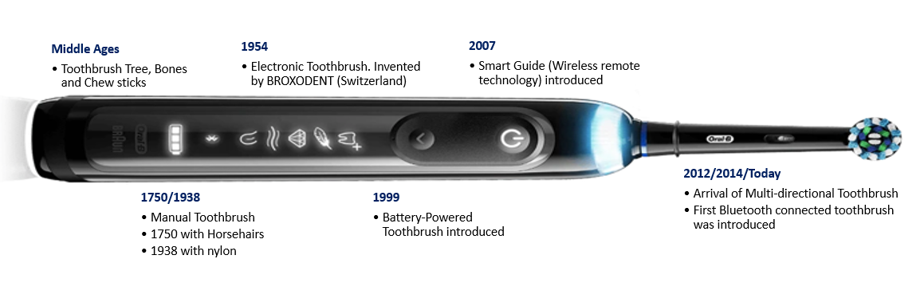
Middle Ages
- Toothbrush: Tree, Bones and Chew sticks
1750/1938
- Manual Toothbrush
- 1750 with Horsehairs
- 1938 with nylon
1954
- Electric Toothbrush. Invented by BROXDENT (Switzerland)
1999
- Battery-Powered Toothbrush introduced
2007
- Smart Guide (Wireless remote technology) introduced
2012/2014/Today
- Arrival of Multi-directional Toothbrush
- First bluetooth connected toothbrush was introduced
History
The new smart sensor technology tooth brush era is allowing dental practitioners and patients to make good and dramatic improvements to their oral health. Brushes have definitely changed over the previous several centuries, with Bluetooth capabilities and built-in times.
The first electric toothbrush was created in 1954. This toothbrush was invented in Switzerland and revolutionized the world of oral health.
Wallace Carothers, a scientist, revolutionized the toothbrush business in 1935. He initiated the switch from animal hair bristles to nylon bristles. This improved oral health and demonstrated nylon's capabilities. It opened the door to a plethora of new industrial possibilities for many years to come.
Early Toothbrushes
Chewing sticks were invented around 3500 BCE. They were merely slender twigs with ragged ends that ancient cultures developed and utilized.
Between 1223 and 1498, the bristle toothbrush was created in China. Those toothbrushes were constructed from stiff, durable animal hairs, most commonly hog hair. They carved small holes in bone or bamboo and inserted the bristles. These would approximate the form of a modern-day toothbrush.
William Addis of England invented the first mass-produced toothbrush in 1780. They were constructed from cattle bone and connected sinew fibers, much like the early Chinese one. For the first time, oral health was promoted and made available to the general population. They continued to use this toothbrush design until the mid-1930s.
Types of Toothbrushes
- Neem Stick
- Miswak
- Prophylactic toothbrush
- Sonicare toothbrush
- Toothbrush with Bluetooth technology
- Smart toothbrush with Bluetooth technology
Smart Toothbrush Prototype
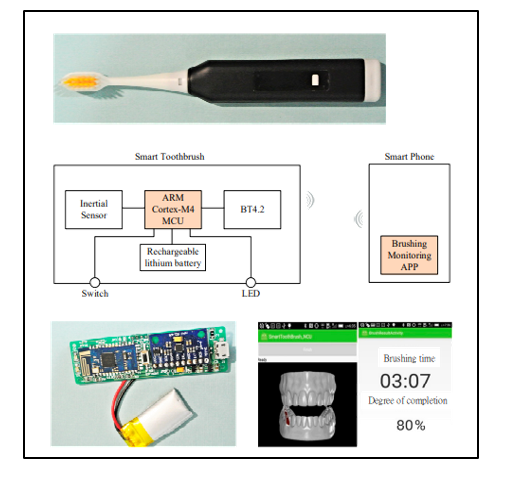
Smart toothbrush prototype system shown in Figure.
- Sensor and Bluetooth module
- The toothbrush has a nine-axis inertial sensor MPU-9255 and a Bluetooth 4.2 module.
- The brushing motion signal was captured by the inertial sensor and the Bluetooth signal was promptly communicated to the mobile phone.
- Mobile-phone application
- On the mobile phone end, software was created to implement RPNN-based Brushing Posture Recognition, as well as a graphical user interface for checking the fidelity of Bayesian brushing.
- Healthcare application
- The application of inertial sensors in the realm of healthcare is particularly significant in several areas of telemedicine domains.
- These studies illustrate that the use of inertial sensors for human activity recognition (HAR) in healthcare applications is advancing rapidly.
Prototype System Components
- Inertial sensor
- MCU
- Bluetooth 4.2
- Rechargeable Li-ion battery
- Mobile phone
- Brushing monitoring APP
- Smart toothbrush hardware and sensor board
Example App Display
- Brushing time: 03:07
- Progress/score shown: 80%
How is a smart toothbrush different from a “normal” and electric brush?
01. Smart toothbrushes are not the same as electric toothbrushes.
Future of Smart Toothbrush will be in multi-functionalities, like teeth cleaning to disease detection in real time with or without user or healthcare person intervention.
02. The heads of an electric toothbrush and a smart toothbrush are both removable, but the motors are not the same.
A standard electric toothbrush has around 2,500 to 7,500 vibrations per minute, while a smart toothbrush has over 30,000 vibrations per minute.
03. A “normal” brush, on the other hand, will have around 300 strokes per minute, depending on how users brush. Smart toothbrushes vibrate at a pace that is about ten times that of an electric toothbrush, claiming to provide a more effective cleaning procedure.
04. The other distinction is in the bristles. A smart toothbrush, like Xiaomi and Realme, would most likely contain antibacterial DuPont bristles. Normal toothbrush bristles can be soft or stiff depending on the user.
Properties
|
Features |
Electric/digital tooth |
Smart toothbrush |
|
Vibrations |
Between 2,500–7,500 per min |
Between 20,000–30,000 per min |
|
App support |
No |
Yes |
|
Bluetooth/Wi-Fi connectivity |
No |
Yes |
|
Brush motion |
Rotating |
Vibration |
|
Battery |
Yes |
Yes |
|
Some brands |
Colgate, Oral-B |
Xiaomi, Realme, Colgate, Oral-B |
Brush Head Monitor
“Always catch the tooth brush motion with the smart brush high level requirement monitor.”
The illustration shows a smartphone application that monitors toothbrush activity and displays the brushing status/progress.
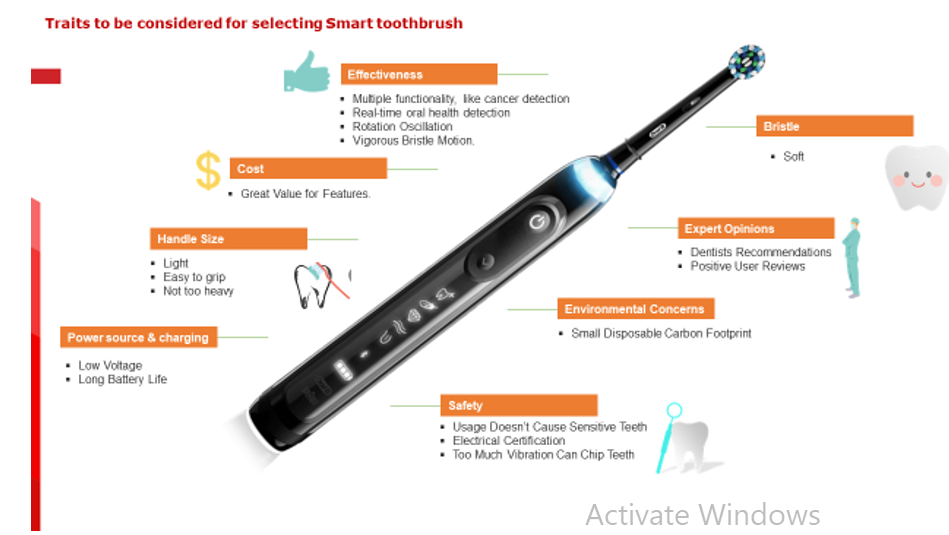
- AI-powered brushing analysis to provide personalized recommendations and detect improper brushing patterns.
- Real-time oral-health monitoring to identify potential problems at an early stage.
- Integration with dental-care platforms, allowing dentists and healthcare professionals to monitor patients remotely when appropriate.
- Advanced sensors capable of detecting pressure, brushing angle, plaque levels and other oral-health indicators.
- Personalized brushing programs based on age, dental condition, sensitivity and individual needs.
- Improved connectivity, including integration with smartphones, smartwatches and other health-monitoring devices.
- Gamification and behavioral feedback to encourage children and adults to maintain consistent brushing habits.
- Longer battery life and sustainable designs, including replaceable or recyclable components.
- Greater affordability and accessibility, so smart oral-health technology can benefit a wider population.
Way forward
The smart toothbrush represents a shift from simply cleaning teeth to actively supporting preventive and personalized oral healthcare. With further development in sensors, AI, connectivity and clinical validation, it has the potential to become an important tool for improving everyday oral-hygiene practices and enabling earlier detection of oral-health problems.
Solutions Driving Innovation & Intelligence


Enabling Fortune 500's, R&D Giants, Law firms, Universities, Research institutes & SME's Around The Globe Gather Intelligence That
Protects and Nurtures Innovation Through a Team of 250+ Techno Legal Professionals.