
Articles
Green Steel: Market Insight & Key Player
Green Steel: Market Insight & Key Player
Global Market Scenario
In 2022, the Global Green Steel Market is in its embryonic stage. The stakeholders in the market are progressively investing in setting up greenfield projects and establishing partnerships & strategic alliances to transform their businesses. The global market is likely to be driven primarily by the mounting inclination of governments in the US, Canada, Germany, France, the UK, etc., toward lowering carbon emissions and adopting sustainable products & manufacturing practices in verticals, such as construction, electronic, industrial equipment, etc.
According to World Steel Association, in 2020, 1,860 MT (Million Tons) of steel was produced globally, which contributed to an average of 1.851 tons of CO2 into the atmosphere. Growing industrial emissions from steel products have compelled organizations to launch strategies and partnerships with private steel-making entities to boost the production of green steel globally.
In August 2020, SAAB, a Swedish steelmaker, announced a joint venture with LKAB & Utility Vattenfall to develop a hydrogen-based primary steel plant in Lulea, Sweden.
Later, in July 2021, ArcelorMittal announced to sign a USD 1 Billion worth Memorandum of Understanding (MOU) with the Spanish Government to develop decarbonization technologies at ArcelorMittal Asturias' plant in Gijon, Spain.
In 2021, the Government of India announced the National Hydrogen Mission to support the country's energy transition goals across all industries. Furthermore, automotive units, such as BMW, in October 2021, announced to use green steel (to be procured from a Swedish steel manufacturer, H2 Green Group) in their automobiles, with an intent to reduce up to 95% Green House Gas (GHG) emissions by 2025.
The Electric Arc Furnace (EAF) technology is expected to gain a significant share in the Global Green Steel Market during the forecast period. Electric arc furnaces have witnessed extensive acceptance for carbon-free steel production. In 2020, Tata Steel announced its plan to produce green steel using the EAF technology. Besides Tata steel, ArcelorMittal, in the same year, announced its strategy of manufacturing fossil-free steel using EAF technology, thereby indicating the considerable hold of EAF in the overall market in the coming years and projecting a notable growth rate.
HYBRIT, in 2021, successfully delivered its first batch of fossil-free steel to truck giant Volvo AB for a trial run of manufacturing prototype vehicles & spare parts.
Increasing collaborations across Europe also suggest the strong future of the Green Steel Market in the region over the forecast years. For instance:
Japan-based Mitsubishi Heavy Industries and Austria-based Voestalpine have joined hands to yield an annual capacity of about 250,000 MT of green steel since 2021, which is a crucial aspect expected to boost the Europe Green Steel Market.
Recent Developments by the Leading Companies: H2 Green Steel, which has almost gathered a series A equity financing of approximately USD 61.1 million, is anticipated to start green steel production by 2024 and would attain 5 million tons of production capacity per year by 2030.
Read Also: Green Steel Overview
Recent private investments into green steel
Vale: Vale has invested US$6 million in Boston Metal, a US-based startup developing steel decarbonisation technologies. They are developing a Molten Oxide Electrolysis (MOE) technology, which reduces metal oxides such as iron ore with the use of electricity. Source: Mining Magazine, February 2021. Vale, Kobe Steel and Mitsui & Co agree to combine green ironmaking solutions. The new venture will use existing and new low-CO2 iron-making technology such as Tecnored® technology and the MIDREX® Process. Source: International Mining, July 2020.
BHP: BHP partners with JFE to address decarbonisation in the steel industry. BHP is prepared to invest up to US$15 million over the five-year partnership. Source: BHP, February 2021. BHP backs Boston Metal in a Series B funding round. BHP Ventures is the internal venture capital unit within BHP, which is seeking to solve critical global challenges through its investments. Source: Mining Magazine, January 2021
ArcelorMittal: ArcelorMittal launched XCarb™, designed to bring together all of their reduced, low and zero-carbon products and steelmaking activities, as well as wider initiatives and green innovation projects, into a single effort focused on achieving demonstrable progress towards carbon-neutral steel. Source: ArcelorMittal, June 2021.
Rio Tinto: Rio Tinto teams up with Paul Wurth and SHS-Stahl-Holding-Saar on low-carbon iron in Canada. The partnership will explore the viability of transforming iron ore pellets into low-carbon hot briquetted iron (HBI), a low-carbon steel feedstock, using green hydrogen generated from hydro-electricity in Canada. Source: Rio Tinto, February 2021.
EIT InnoEnergy and other strategic investors: These companies have helped H2 Green Steel raise US$105 million in its first round of venture capital financing. The Swedish group aims to start production just below the Arctic Circle in 2024 and plans to produce five million tonnes of emission-free steel by the end of the decade by using hydrogen produced with renewable energy to make the alloy rather than the traditional way of burning coke. Source: FT, May 2021.
SSAB, LKAB and Vattenfall: The joint initiative has commenced building a rock cavern storage facility for fossil-free hydrogen gas on a pilot scale next to HYBRIT's pilot facility for direct reduction in Luleå, North of Sweden. This is an important step in the development of a fossil-free value chain for fossil-free steel. The investment cost of just over SEK 250 million is divided equally across the holding companies and the Swedish Energy Agency, which provides support via Industriklivet. Source: SSAB, April 2021.
Read Also: Green Steel: Technology Trends
Emerging Technologies in Green Steel
Kobe’s increased blast furnace efficiency:
Japanese steel manufacturer Kobe Steel recently developed a new technique for creating steel in natural gas blast furnaces that use less coke, a raw
material with a high carbon content used in steel production. By adding hot briquetted iron, HBI (iron ore with the oxygen removed) to the blast furnaces as a fuel source at a precise ratio, Kobe said it has perfected a way to maintain the efficiency of the CO2 reduction process and use less coke as fuel.
According to Kobe, the process reduces CO2 emissions associated with production by about 20 percent. While this is not a final solution to the steel industry’s carbon emission woes, Kobe is positioning this as a transitional technology to help reduce emissions while it develops more drastic changes. But Blank sees this as a risky and expensive investment in something that might be obsolete in a few years if the steel industry is trying to get to net-zero emissions by 2050.
EIT InnoEnergy’s hydrogen steel plant:
Hydrogen offers one possibility of a completely carbon dioxide-free process for making steel, according to some experts. In traditional blast furnaces, coal is used to strip the oxygen out of the iron ore, creating steel and CO2. According to the Fuel Cell & Hydrogen Energy Association and by using hydrogen instead of coal for that process, the byproduct is water (H2O) instead of CO2.
A partnership between Netherlands-based EIT InnoEnergy, a sustainable innovations accelerator funded by the European Union, investor Vargas Holdings and Scania, a Swedish truck manufacturer, is working to bring this dream to a commercial reality. These partners are developing a fully scaled commercial hydrogen steel plant called H2 Green Steel. The plant will produce 5 million metric tons of green steel by 2024, making it the largest green steel plant in the world, according to the partners.
Boston Metal’s molten oxide electrolysis:
A new technology originally created at MIT, molten oxide electrolysis, aims to separate the oxygen from the iron ore using electricity and creating O2 as the byproduct instead of CO2. Boston Metal is tasked with bringing this technology to a commercial level for the steel industry.
Over the next two to three years, the company hopes to take its laboratory success and bring it to market. It’s focusing on regions such as Europe, Canada and Australia where there is easy access to renewable energy because like hydrogen steel, the electrolysis process requires access to large amounts of clean power to keep the process carbon-free all the way down the pipeline. Boston Electrometallurgical Corp also filed a patent on systems and methods for molten oxide electrolysis (US20200263313A1).
Top Affiliations-Non-Patent
Insight:
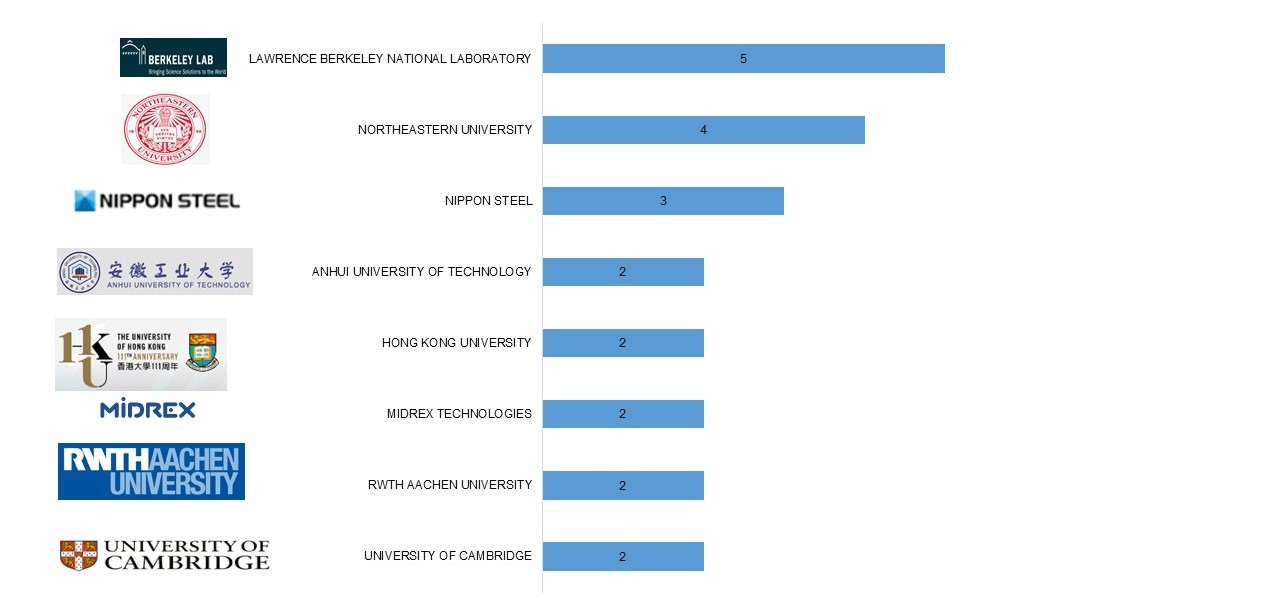
- Northeastern University has 4 publications and Lawrence Berkeley National Laboratory has 5 non- patent publications.
- Northeastern University has 4 publication out of which 2 discloses about carbon direct avoidance and one discloses about circular economy they also have a publication which discloses about both circular economy and smart carbon usage pathway.
- The raw material used are scrap steel and iron.
- The university discloses about incorporating blast furnace, electric furnace and reheating furnace for smelting of raw materials.
- The product production process includes steps of casting and rolling which results in the formation of high strength steel wire rod and steel wire.
- The publications of Lawrence Berkeley National Laboratory majorly focuses circular economy pathway and out of 5 only one publication is on carbon direct avoidance pathway.
Top Affiliations vs Non-Patent Focus
Insight:
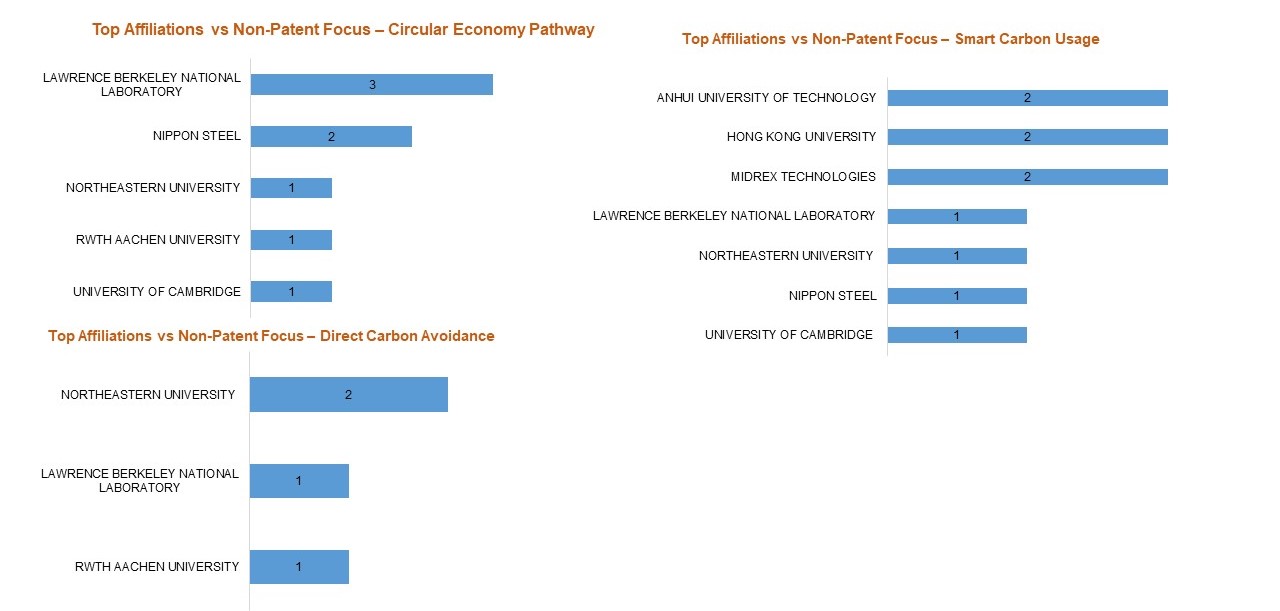
- Northeastern University has 4 publication out of which 2 discloses about carbon direct avoidance and one discloses about circular economy they also have a publication which discloses about both circular economy and smart carbon usage pathway.
- The publications of Lawrence Berkeley National Laboratory majorly focuses circular economy pathway and out of 4 only one publication is on carbon direct avoidance pathway and 3 are on circular economy.
- Anhui University of technology, Hong kong university, Midrex technologies majorly focuses on methods and process for carbon recovery in the smart carbon usage pathway all three have 2 publications each in this category where they use scrap steel as raw material and integrated reduced use of carbon for steel production.
About Effectual Services
Effectual Services is an award-winning Intellectual Property (IP) management advisory & consulting firm offering IP intelligence to Fortune 500 companies, law firms, research institutes and universities, and venture capital firms/PE firms, globally. Through research & intelligence we help our clients in taking critical business decisions backed with credible data sources, which in turn helps them achieve their organisational goals, foster innovation and achieve milestones within timelines while optimising costs.
We are one of the largest IP & business intelligence providers, globally serving clients for over a decade now. Our multidisciplinary teams of subject matter experts have deep knowledge of best practices across industries, are adept with benchmarking quality standards and use a combination of human and machine intellect to deliver quality projects. Having a global footprint in over 5 countries helps us to bridge boundaries and work seamlessly across multiple time zones, thus living to the core of our philosophy - Innovation is global, so are we !!!
Solutions Driving Innovation & Intelligence


Enabling Fortune 500's, R&D Giants, Law firms, Universities, Research institutes & SME's Around The Globe Gather Intelligence That
Protects and Nurtures Innovation Through a Team of 250+ Techno Legal Professionals.