
Articles
Green Hydrogen Production - Part 3
Green Hydrogen Production - Part 3
Clean and efficient gasification of non-recyclable waste
Boson Energy to Produce Carbon Negative Green Hydrogen from Non-recyclable Waste
By maximizing the Hydrogen potential in non-recyclable waste and biomass; we create local, sustainable and profitable ecosystems running on renewable Hydrogen. Our mission is to bring clean air to future generations by solving the world’s waste problem.
+352 20 40 40 20
Hydrogen is a key energy vector to move away from polluting and inefficient combustion-based energy towards clean and efficient electrification. Distributed thermochemical recycling of non-recyclable waste allows Boson to deliver high and predictable volumes of local Hydrogen. This at a quality and price that can compete head-on with diesel and fossil Hydrogen, while at the same time radically cutting emissions and creating additional sector coupling synergies, like grid-independent Hydrogen-powered speed charging.
Conventional Technologies
Conventional fossil Hydrogen from natural gas has a big carbon footprint and carbon capture can reduce that, but not more.
Hydrogen from electrolysis with renewable electricity has a very low carbon footprint, but it is still positive. As a consequence, neither will reverse carbon emissions by being carbon-negative.
Technology with A Strong Business Case
Boson’s integrated system radically improves environmental and financial performance compared to incineration for the very same waste streams.
Benefits include:
- Some 3x higher revenue and more than 10x higher profitability per ton treated to distribute across the value chain, compared to conventional incineration.
- Carbon negative at much lower cost than any other technology.
- Zero ash and radically reduced NOx and PM emissions.
- Water footprint cut so deep that we can even produce water.
Boson Energy ready to step on the gas for green hydrogen
A local Hydrogen ecosystem is a municipality or city sourced with local, renewable 24/7 Hydrogen – creating independence from large-scale Hydrogen distribution systems. Imagine zero-emission waste transportation, buses, trucks, commercial vehicles, port operations, and local boats and ships running on Hydrogen produced from nothing but the local Ecosystem’s own waste.
The pilot plant of Boson Energy, the Luxembourg cleantech company capable of producing green hydrogen from non-recyclable waste, will be set up in Göttingen, Germany, with financing of €100m in the pipelines.
Direct Hydrogen from waste has many advantages compared to other production solutions. Benefits include the abundance of local waste and biomass, the 24/7 production and availability, the climate mitigation from being carbon negative, the positive environmental impact, the system efficiency gains, the light distribution infrastructure, the diesel-parity price, and the resulting profitability, local energy security and quality of life of all these benefits combined.
Truly carbon negative Hydrogen
Circular Hydrogen from waste and biomass is the most cost efficient way to achieve carbon-negative Hydrogen. Landfills emit the greenhouse gas methane and waste incineration emits CO2 mixed into its flue gases. Capturing that CO2 is very expensive. Boson captures the CO2 straight from the thermochemical process, allowing for a carbon-negative footprint at an attractive cost.
Conventional fossil Hydrogen from natural gas has a big carbon footprint and carbon capture can reduce that, but not more. Hydrogen from electrolysis with renewable electricity has a very low carbon footprint, but it is still positive. As a consequence, neither will reverse carbon emissions by being carbon-negative.
Clean and efficient gasification of non-recyclable waste
Boson’s Hydrogen-capable Plasma Assisted Gasification technology (HPAG) produces Hydrogen for direct local use from a wide range of non-recyclable solid wastes by applying high-temperature thermochemical recycling. At a yield of some 100kg of Hydrogen per ton of waste, the process is safe, sustainable and financially attractive for all stakeholders in the waste value chain.
Standard unit treatment capacity starts at 32k tons of waste per year for mixed non-recyclable waste and 8k tons per year for medical and hazardous wastes. Site capacity can be scaled up by adding standard units.
‘We will produce carbon-negative green hydrogen from non-recyclable waste at zero or below-zero cost’
The process will essentially create several revenue streams says Boson CEO Jan Grimbrandt.
The hydrogen, green carbon dioxide and rock would be sold for profit, while the company would also receive a gate fee from local authorities and recycling companies for treating the waste, and carbon credits for avoiding landfill methane emissions.
Despite being a greenhouse gas, carbon dioxide is an important product used by various industries, including carbonated drinks, food processing, food packaging and greenhouses, and is typically derived from fossil fuels. It could also be used to help cure cement and other construction materials, which would fix the carbon dioxide, preventing its release into the atmosphere.
“If we do our business development right we can actually bring the cost of hydrogen to zero or even past zero and go negative because we have other revenue streams,” says Grimbrandt. According to Boson, the process will produce about 100 kg of carbon negative hydrogen for every ton of waste and require six times less renewable electricity per ton than green hydrogen derived from water electrolysis.
Boson Energy says it will offset the expense of producing H2 with the income from its production process' associated revenue streams
According to Boson, the process will produce about 100kg of carbon-negative hydrogen for every tonne of waste - and require six times less renewable electricity per tonne than green H2 derived from water electrolysis.
And with about two billion tonnes of non-recyclable waste being dumped or incinerated globally each year, the potential market is enormous.
Hydrogen Storage

Hydrogen Transportation
Pipelines: Transmission of hydrogen as a gas by pipeline is generally the cheapest option if the hydrogen needs be transported for distances of <1500 km.
- Road tankers: Liquefied hydrogen can be cost effectively delivered over relatively longer distances using road tankers cover a range of around 1,000 km with capacities of 3,000 - 4,000 kg of hydrogen.
- For distances <350 Km with capacities of around 500 Kg of hydrogen, gaseous tube trailers can be a more cost-effective method.
- Rail, barge, and ship: Can offer higher weight limits and delivery capacities over gaseous tube trailers and road tankers
- For longer distances, Hydrogen carriers, such as liquid organic hydrogen carriers (LOHCs) or ammonia, could be more suitable than gaseous or liquid hydrogen.
- European Marine Energy Centre on the northern Orkney Island, Eday is producing “Green Hydrogen” locally and supplies the hydrogen fuel cell installed at Kirkwall Harbor via new Hydrogen Tube trailers capable of carrying up to quarter ton of hydrogen gas.
- Uniper and its consortium partners, are seeking to build an electrolysis plant in the central German chemical triangle.
- The green hydrogen will be placed in underground interim storage in a salt cavern outfitted especially for this purpose and can be fed into the chemical industry’s hydrogen grid via a rededicated gas pipeline and utilized for urban mobility solutions.
Market Information
Market Projections
Potential Market Sectors

Market Analysis (Recent Developments in Steel-making Industry)
Teaming up for a Greener Future
Prominent Universities
In September 2018, the Australian Renewable Energy Agency (ARENA) offered USD 22.1 million in funding 16 green hydrogen export research projects to nine Australian universities and research organizations including:
- Australian National University
- University of New South Wales
- Monash University
- Commonwealth Scientific and Industrial Research Organization (CSIRO)
- Queensland University of Technology
- RMIT University
- The University of Melbourne
- Macquarie University
- The University of Western Australia
In March 2019, JXTG Nippon Oil & Energy Corporation, Chiyoda Corporation, the University of Tokyo and Queensland University of Technology (QUT) announced the successful testing of the world's first production of CO2-free hydrogen at low cost in Australia and its transportation to Japan.
In October 2018, Tohoku University and Maekawa Manufacturing Co., Ltd. also demonstrated the continuous operation for 72 hours (3 days) of a combined power and hydrogen energy storage system at the Moteiwa Water Treatment Plant in Sendai City.
The combined system does not require fossil fuels, can stably supply high-quality power against long-term power outages in the event of a large-scale natural disaster, and enables the effective use of renewable energy even with irregular fluctuations in solar power output and power consumption.
Key Players in India
Tata Motors with IOCL is working on Fuel Cell Electric Buses and recently launched two Hydrogen Fuel Cell buses in Pune.
Southern Petrochemical Industries Corporation Science Foundation (SPICSF) is developing “Polymer Electrolyte Membrane Fuel Cell”(PEMFC) technology for applications in stationary(UPS system, etc.), portable and transportation.
Indian Institute of Technology (IIT), Madras is working on new catalysts, catalysts metal-alloys and membranes for use in PEM fuel cells.
Bharat Heavy Electricals Limited (BHEL) is currently working on PAFC technology for distributed power generation. (50kW stack PAFC technology)
Indian Institute of Science (IISc), Bangalore and Central Glass & Ceramic Research Institute (CGCRI), Kolkata are developing Solid Oxide Fuel Cell (SOFC) technology for stationary applications.
Mahindra & Mahindra Ltd is working on fuel cell and hybrid vehicles.
National Chemical Laboratory (NCL), Pune Synthesized proton-conducting membranes using surface fractionalization, which can be use as electrolytes in batteries and fuel cells.
Pricing and Policy Concerns
Pricing Factors
- First and foremost, the prices of Green hydrogen depend on the price of renewables used for production.
- Secondly, the prices of green hydrogen depend on the buyer’s or producer’s location as the prices of everything from the cost of renewables used to the cost of electricity depend upon the geographical location.
- The form of hydrogen i.e. liquid or gaseous, also play an important role as it effects the mode of transport and distribution of hydrogen when it is produced centrally on a large scale and transported to points of use.
- Higher the purity, higher the price
- The countries and regions blessed with abundant sunshine and wind power – such as the Middle East, North Africa and Latin America will have an edge over other regions in setting in-house production plants, as the cost of green electricity is considerably lower In these regions.
- Swedish power company, Vattenfall has calculated that producing a €20,000 car from CO2-free steel (using green hydrogen) rather than regular steel would add just €200 to the price.
- A premium market could be developed for consumers willing to pay 1% to 3% more for products manufactured using green hydrogen.
- Hydrogen prices for end-use consumers of automobile industry are highly dependent on how many refuelling stations there are, how often they are used and how much hydrogen is delivered per day.
- Co-ordination between governments, industries and investors to collectively set up policies and bring down prices of hydrogen production and distribution.
Policies & Safety Concerns
Policies
Government needs to play an important role in setting goals for future of clean hydrogen use and to encourage industries to invest In the development by incentivising their efforts.
- The Dutch government has announced the broadening of its low-carbon program which is currently restricted to subsidies for producing renewable energy. It will soon be expanded to include all possible cost-effective ways to reduce CO2 which will help the market-driven activation of blue hydrogen projects and, depending on how costs evolve, hopefully that of green hydrogen projects in the near future.
- France’s hydrogen strategy includes indicative targets of 10% green hydrogen use in industry for 2022 and 20% to 40% for 2027.
- The United States have their own hydrogen policy.
- Japan has several important pilot projects underway – with countries including Australia, Saudi Arabia and Brunei – to determine the best way to transport green or blue hydrogen over large distances by ship.
- In its latest five-year plan (2016-2020), China has extended support towards adoption of green Hydrogen in industrial sector. Local companies are encouraged to acquire the technologies for hydrogen production, storage and fuel cell systems in order to achieve the large-scale deployment of HRS and other fuel cell applications.
Safety Concerns
The use of green Hydrogen in the industry also raises some safety concerns which need to be catered as well as standardised to promote the safe integration of green hydrogen into the industrial sector.
- Requirement of leak detection systems as well as Emergency Evacuation plan for Hydrogen leaks.
- Installation of explosion- proof or explosion relief systems, hydrogen process shut-down systems and suitable fire extinguishing system.
- New flame detectors for high-blending ratios as hydrogen flame is not very bright when burning.
- Providing adequate ventilation, designing and operating to eliminate potential ignition sources.
- Barriers or safeguards should be provided to minimize risks and control failures.
- Some standard codes related to use of Hydrogen in the industrial sector:
- ISO 19880-3:2018 (published June 2018)
- ISO 16111:2018 (published August 2018)
- SAE J2579: (revised June 15, 2018)
- IEC 62282-5-100 (published April 2018)
- SAE J3089 (passed second ballot in FY2018)
- ANSI FC (approved and published in mid-2018).
Hydrogen Associations
International Associations
- The International Energy Agency (IEA) acts as a policy adviser to its 30 member states including US, UK, France, Australia etc.
- IEA established an agreement on the Production And Utilization Of Hydrogen in 1977 to pursue collaborative hydrogen research and development and information exchange among its member nations.
- IEA provides a number of concrete policy recommendations that range from identifying long-term goals and stimulating commercial demand for clean hydrogen to addressing investment risks, supporting R&D to bring down costs and eliminating regulatory.
- India joined the IEA as an association country in March 2017.
- Mission Innovation is a global initiative of 24 countries and the European Commission working to accelerate clean energy innovation.
- The member countries of the initiative have agreed on the doubling of R&D in clean hydrogen; removing fossil fuel subsidies and guarantees of origin for blue and green hydrogen.
- The member countries are also working on developing common quality and safety standards; and aligned regulatory approaches
- In 2017, Hydrogen Council, a global initiative, was launched in Davos by 100 companies which now comprises over 60 members, including major energy and transport companies (Daimler, BMW, Honda, Toyota etc.)
- Hydrogen, scaling up, a report Published in November 2017, outlines a comprehensive and qualified roadmap for wide-scale deployment of hydrogen for decarbonization of transport, industry and buildings, and enabling a renewable energy production and distribution system.
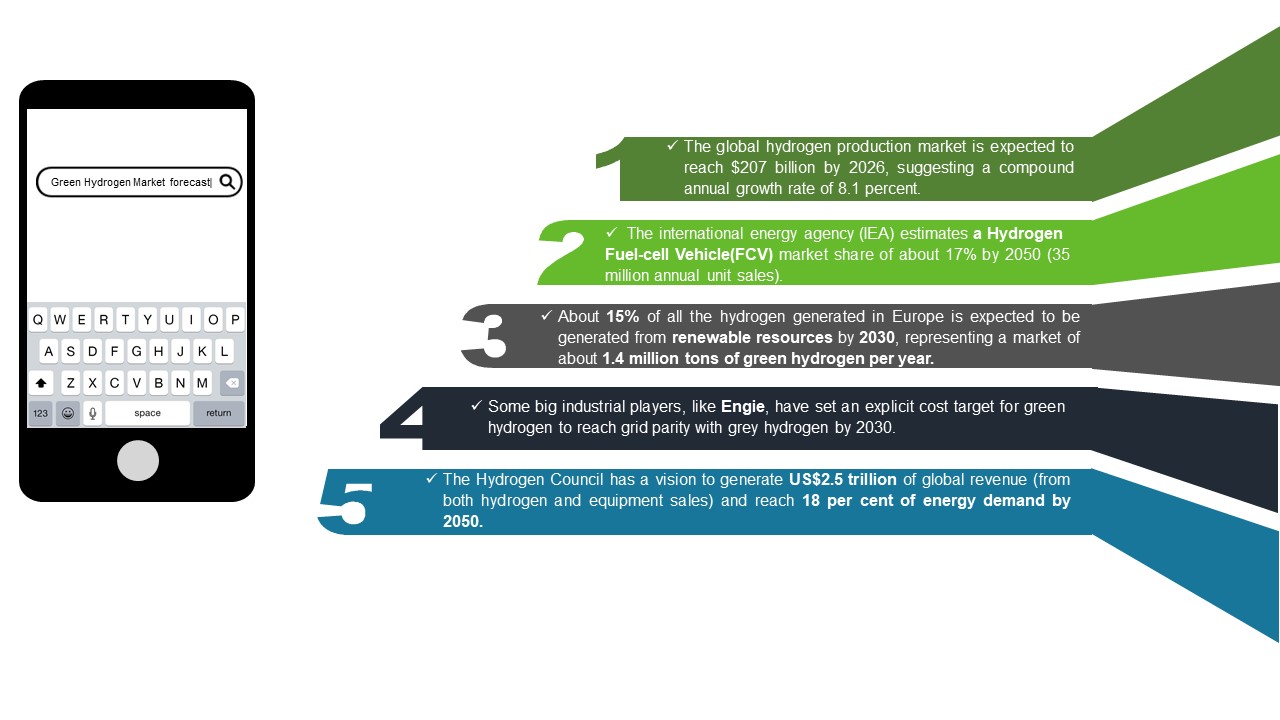
- The Hydrogen Council has a vision to generate US$2.5 trillion of global revenue (from both hydrogen and equipment sales) and reach 18 per cent of energy demand by 2050.
National Associations
- In 2018, Chinese companies created a Hydrogen Council similar to the global one, gathering major Chinese energy and transport companies, chaired by the chief executive of China Energy.
- The Hydrogen Initiative was launched by the Austrian presidency and signed in Linz in September 2018.
- The signatories of the initiative collectively aim to increase the integration of hydrogen, deployment of storage options for renewable hydrogen and setting standards to ensure maximum consistency for implementing hydrogen technology.
- Hydrogen Energy Programme started in India after it joined the IPHE (International Partnership for Hydrogen Economy) in 2003.
- The National Hydrogen Energy Road Map (NHERM) is a program in India initiated by the National Hydrogen Energy Board (NHEB) in 2003 for bridging the technological gaps in different areas of hydrogen energy, including its production, storage, transportation and delivery etc.
- Hydrogen Coalition, a group of 27 environmental organizations, knowledge institutions, governments and companies - including network operators and heavy industry (including Tata Steel and AkzoNobel) was set up in the Netherlands.
- The Hydrogen Coalition calls the government to take action to stimulate green hydrogen to enhance the sustainability of the energy supply.
- Recently, new National Hydrogen Associations were launched in Chile and Ukraine.
- Chile is promoting the creation of projects in four areas: mining transport, storage of hydrogen, green ammonia-based fertilizers and, even, the export of green hydrogen.
- The Ukrainian Hydrogen council aims to make renewable and hydrogen energy technologies available to communities through the support of energy saving programs and energy decentralization.
About Effectual Services
Effectual Services is an award-winning Intellectual Property (IP) management advisory & consulting firm offering IP intelligence to Fortune 500 companies, law firms, research institutes and universities, and venture capital firms/PE firms, globally. Through research & intelligence we help our clients in taking critical business decisions backed with credible data sources, which in turn helps them achieve their organisational goals, foster innovation and achieve milestones within timelines while optimising costs.
We are one of the largest IP & business intelligence providers, globally serving clients for over a decade now. Our multidisciplinary teams of subject matter experts have deep knowledge of best practices across industries, are adept with benchmarking quality standards and use a combination of human and machine intellect to deliver quality projects. Having a global footprint in over 5 countries helps us to bridge boundaries and work seamlessly across multiple time zones, thus living to the core of our philosophy - Innovation is global, so are we !!!
Solutions Driving Innovation & Intelligence


Enabling Fortune 500's, R&D Giants, Law firms, Universities, Research institutes & SME's Around The Globe Gather Intelligence That
Protects and Nurtures Innovation Through a Team of 250+ Techno Legal Professionals.