Articles
Green Hydrogen Production - Part 2
Green Hydrogen Production - Part 2
Renewable Energy Sources for Green Hydrogen Production
A variety of renewable energy sources are used for production of green hydrogen. This slide presents only the major ones.
Includes artificial photosynthesis module as renewable energy source.
Japan Technological Research Association Of Artificial Photosynthetic Chemical Process (ARPChem) in collaboration with FUJIFILM has filed many patents disclosing use of photosynthesis for green hydrogen production.
Majorly used in the form of steam for renewable electricity generation that comes from reservoir of natural hot water spring.
New Zealand based firm Halcyon Power joins hands with Japan based Canadian Hydrogenics Corp. to install a 1.5 MW hydrogen production facility at the Mokai geothermal power plant in New Zealand. The plant is expected to start production by 2020.
In September 2019, U.S. Department of Energy has announced partnership with Idaho National Laboratory to set up nuclear plants to produce carbon-free hydrogen.
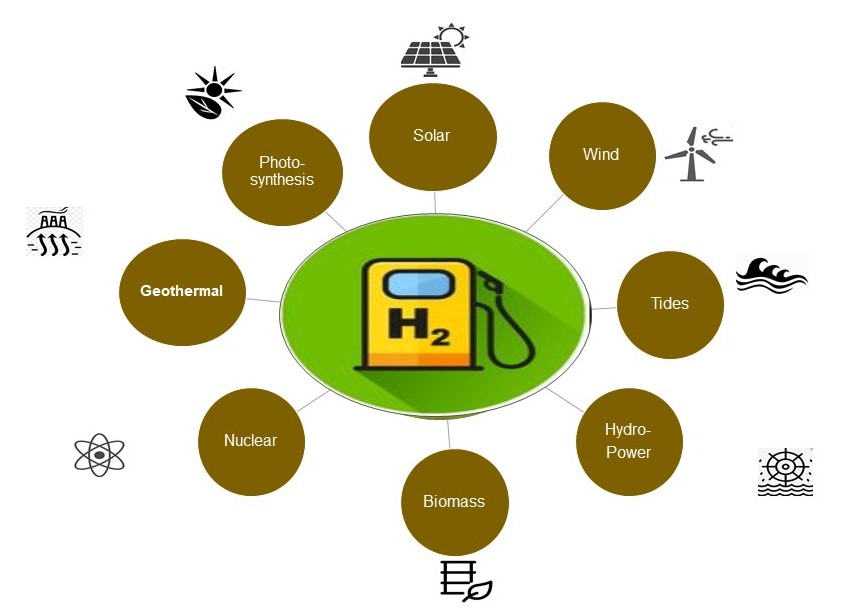
Biomass can be converted into energy for green hydrogen production by variety of methods such as dark fermentation, enzymes.
Solar renewable energy source is most prominently used with photovoltaic process for the production of green hydrogen.
~50% patent data in the domain of green hydrogen is focused on use of solar energy.
Wind renewable energy source is primarily focused alongside solar energy by various players.
A projected scale-up in offshore wind production in northwest Europe is expected to kick in over the next 10 to 15 years.
At 7 meters per second average wind speed, it would require 1 million 2-MW wind turbines, which would cost $3 trillion, or about $3.00 per GGE.
First tidal-powered hydrogen was generated by European Marine Energy Centre (EMEC) in the year 2017.
The first 2 MW electrolysis facility for the production of green hydrogen in Switzerland will become operational at the Gösgen hydropower plant (operated by the Kernkraftwerk Gösgen-Däniken AG) at the end of 2019.
Processes of Green Hydrogen Production
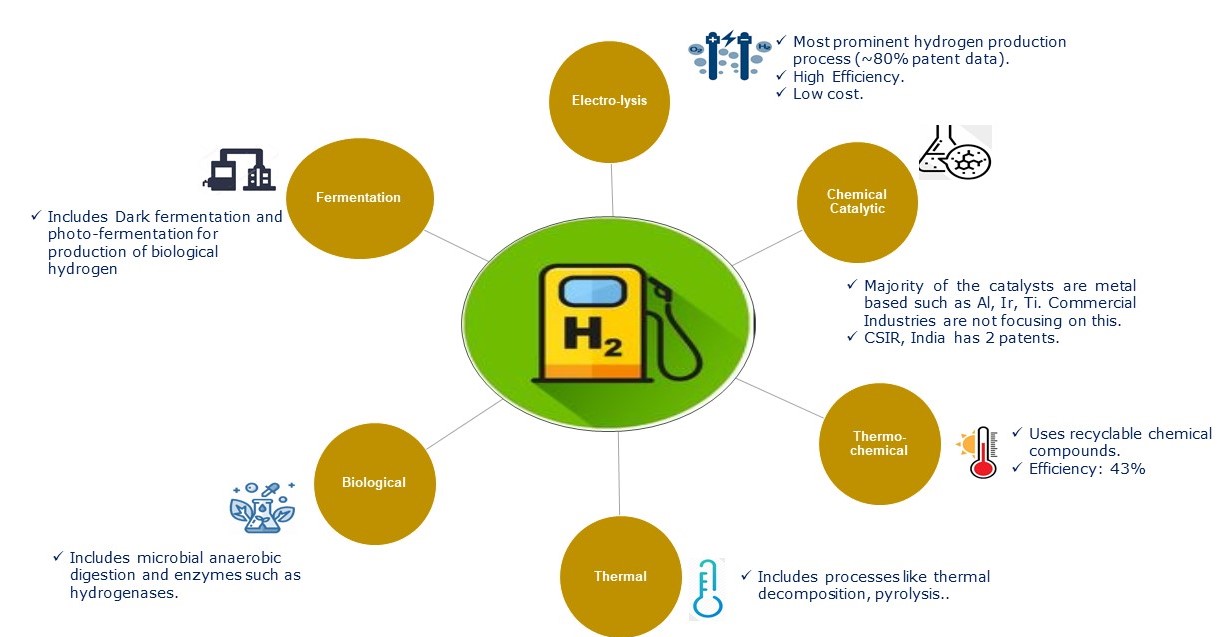
Type of Electrolysis for Green Hydrogen Production
Electrolysis is the most prominent green hydrogen production process as indicated on Slide 6. This slide presents only the major methods of performing electrolysis.
Microbial Electrolysis
- Assisted by microbial decomposition of organic material, wherein the microbes are attached at anode of the fuel cell.
- This is a very niche area currently.
Proton exchange membrane (PEM) Electrolysis
- Introduced by GE in 1960s
- Reduces operational costs, especially for systems coupled with very dynamic energy sources such as wind and solar, wherein sudden spikes in energy input would otherwise result in uncaptured energy.
- Commercially available with Efficiency: 80-90%
Photo-Voltaic Electrolysis
- Most prominent type of electrolysis disclosed in patent data.
- Many big industrial players such as Hitachi and Sumitomo have shown IP activity
Photo-Catalytic Electrolysis
- A suitable photocatalyst for overall water splitting should have a band gap of at least 1.23 eV with no photocorrosion.
- To improve solar energy efficiency, modification of photocatalysts can be made by doping with some transition metal cations such as Ni2+, Cr3+, and V5+.
Photo-Electro-Chemical Electrolysis
- Electrolysis using semiconductors and energy from sunlight
- To improve efficiency, this process can be coupled with photocatalysts suspended directly in water
Read Also: Green Hydrogen Production - Part 1
Hydrogen Value Chain
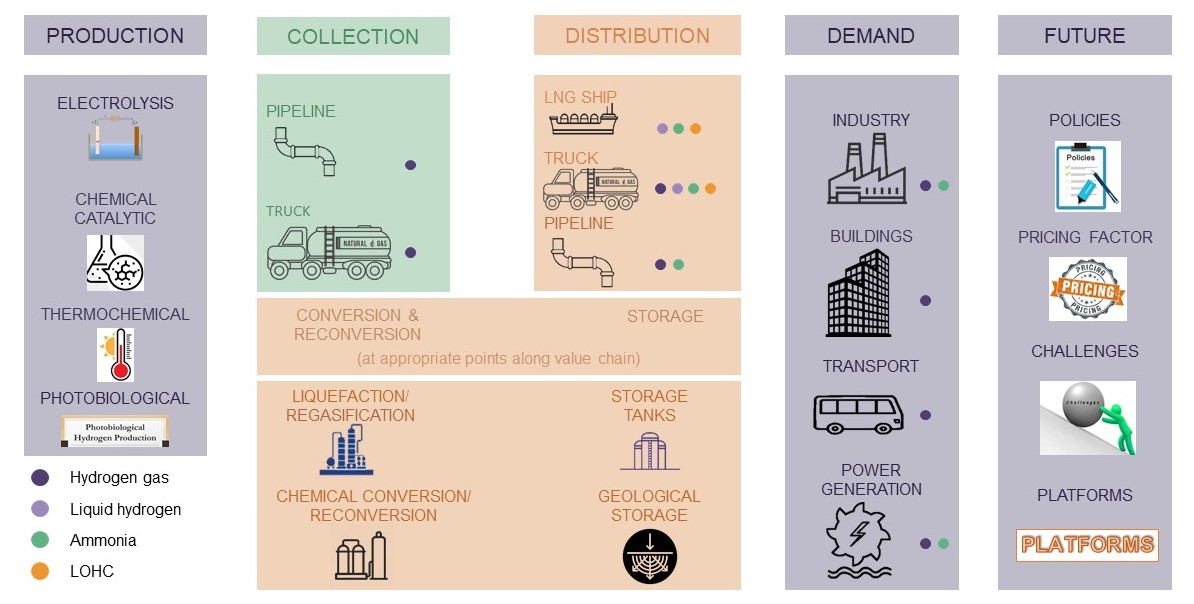
Of Gchallenges to Adoption Reen Hydrogen (Compatibility Issues)
- Due to the intermittent nature of renewable electricity production, the production of green hydrogen cannot be continuous.
- Development of infrastructure for integration of green hydrogen into industries requires significant financial commitment, the highest being for the steel industry.
- Electrolysis is expensive and inefficient. Only 62% of the initial electric energy supplied is converted into heat energy at the output.
- For steelmaking industry, currently, the cost of 1kg of carbon in Europe is around 0.25€. The cost of SMR-derived hydrogen, however, is around 1.5-2€/kg, and that of electrolytic hydrogen, depending on electricity prices, is even higher. So the cost of hydrogen is going to impact its use as a reducing agent.
- Hydrogen pipelines are more expensive than even long-distance electric lines. Hydrogen is 3x bulkier in volume than natural gas for the same enthalpy. Hydrogen accelerates the cracking of steel, which increases maintenance costs, leakage rates, and material costs.
- Hydrogen is flammable, colorless and odorless, which makes safety checks more difficult.
- Government regulations in certain regions limit the development of clean hydrogen industry. Government and industry must work co-operatively to ensure that the regulations meant to encourage growth are not an unnecessary barrier to investment.
Green Hydrogen Production Processes
Alkaline Electrolysis
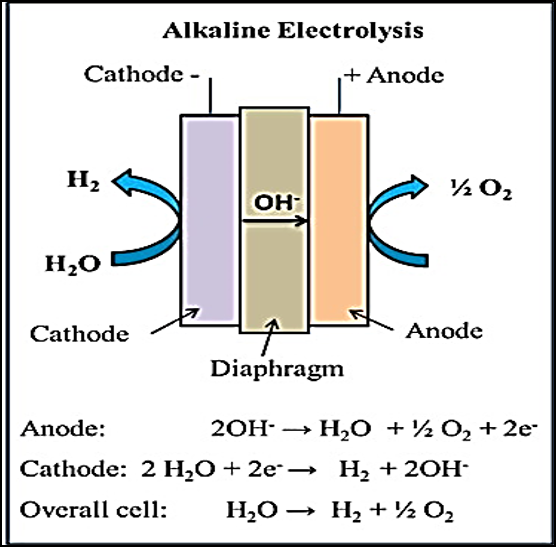
Negative aspects such as limited current densities (below 400 mA/cm2), low operating pressure and low energy efficiency, high electricity consumption - Relatively low efficiency and high production cost, compared with hydrocarbon reforming.
Proton Exchange Membrane Electrolysis

In PEM water electrolysis, water is electrochemically split into hydrogen and oxygen at their respective electrodes.
PEM water electrolysis is accrued by pumping of water to the anode where it is spilt into oxygen (O2), protons (H+) and electrons (e−).
AEM Electrolysis
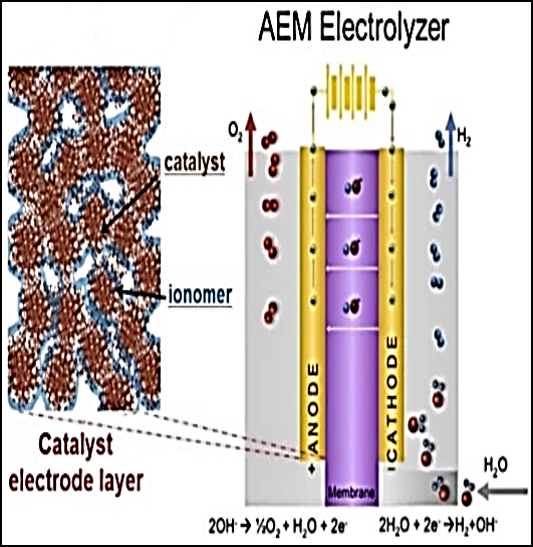
AEM electrolysis is a combination of a PEM and alkaline electrolysis technology.
Benefits: low-cost, energy efficient, can use rain or tap water, and is stackable.
High-temperature electrolysis (HTE)

High temperature electrolysis is conducted in solid oxide electrolysis cells (SOEC).
Photo-biological
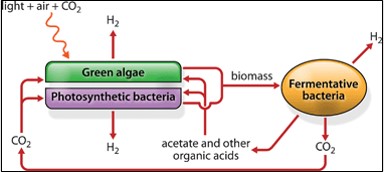
Photo biological hydrogen production process uses microorganisms and sunlight to turn water, and sometimes organic matter, into hydrogen.
Thermo-chemical water splitting
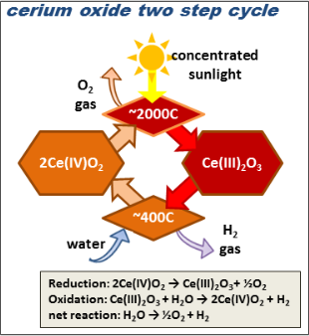
Thermochemical water splitting uses high temperatures - from concentrated solar power and chemical reactions to produce hydrogen and oxygen from water with potentially low or no greenhouse gas emissions.
Challenges so far:
- Efficiency & durability of reactant materials
- Reactor designs compatibility with high temperatures and heat cycling.
- Cost of the concentrating mirror systems.
Photo-electrochemical water splitting

Photoelectrochemical (PEC) water splitting, hydrogen is produced from water using sunlight and specialized semiconductors called photoelectrochemical materials, with the potential for low or no greenhouse gas emissions.
About Effectual Services
Effectual Services is an award-winning Intellectual Property (IP) management advisory & consulting firm offering IP intelligence to Fortune 500 companies, law firms, research institutes and universities, and venture capital firms/PE firms, globally. Through research & intelligence we help our clients in taking critical business decisions backed with credible data sources, which in turn helps them achieve their organisational goals, foster innovation and achieve milestones within timelines while optimising costs.
We are one of the largest IP & business intelligence providers, globally serving clients for over a decade now. Our multidisciplinary teams of subject matter experts have deep knowledge of best practices across industries, are adept with benchmarking quality standards and use a combination of human and machine intellect to deliver quality projects. Having a global footprint in over 5 countries helps us to bridge boundaries and work seamlessly across multiple time zones, thus living to the core of our philosophy - Innovation is global, so are we !!!
Solutions Driving Innovation & Intelligence


Enabling Fortune 500's, R&D Giants, Law firms, Universities, Research institutes & SME's Around The Globe Gather Intelligence That
Protects and Nurtures Innovation Through a Team of 250+ Techno Legal Professionals.