
Articles
Top Assignees of Advanced Metering Infrastructure (AMI)
Top Assignees of Advanced Metering Infrastructure (AMI)

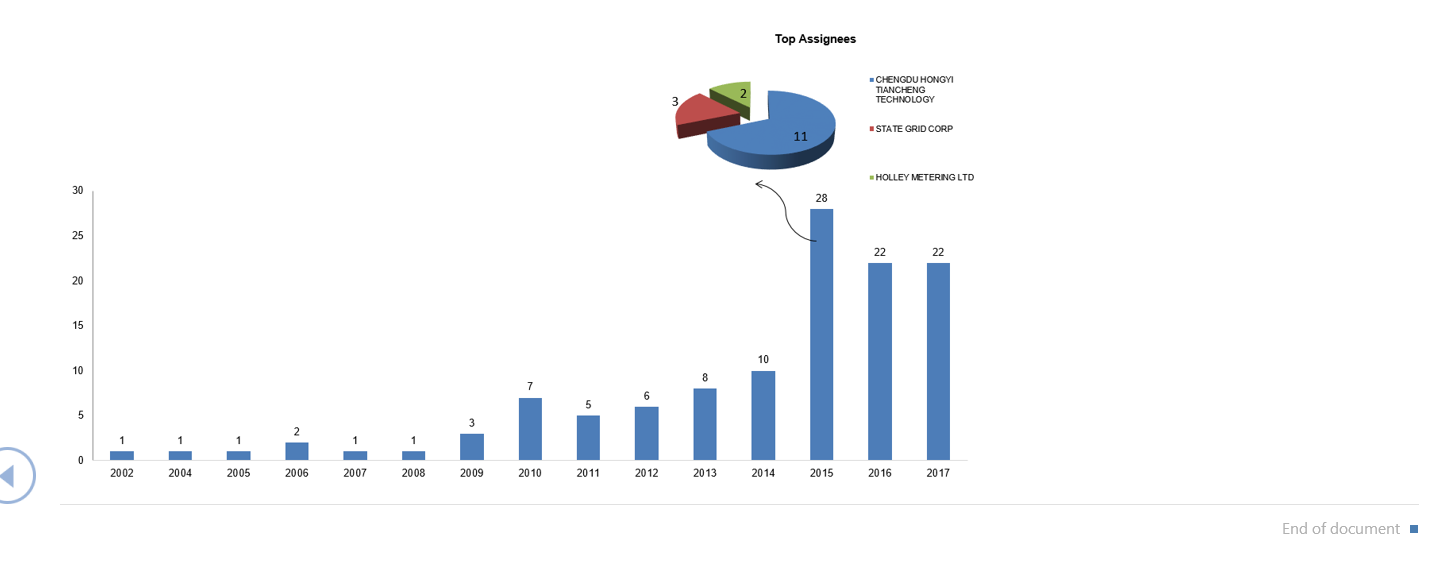
The patent ownership landscape for Advanced Metering Infrastructure (AMI) reveals a highly concentrated innovation ecosystem, where a single assignee dominates the patent portfolio while only a few organizations contribute comparatively smaller numbers of patent families. As illustrated in the chart, the leading assignee owns 11 patent families, whereas the second and third assignees each hold 2 patent families. This distribution indicates that innovation in AMI is largely driven by one key player, with a limited number of competitors actively participating in patent development.
The dominance of the leading assignee demonstrates a strong commitment to research and development (R&D) in smart metering technologies. Holding 11 patent families, which account for approximately 73.3% of the total patent portfolio represented in the chart, this assignee has established a significant technological advantage. Such an extensive patent portfolio is typically associated with continuous investments in next-generation metering solutions, communication protocols, grid automation, and intelligent energy management systems. A broad intellectual property (IP) portfolio also enables the organization to protect its innovations, strengthen its market position, and gain strategic advantages through licensing opportunities and technology collaborations.
The technological focus of the leading assignee is likely to span multiple aspects of AMI, including smart electricity, water, and gas metering, real-time energy consumption monitoring, bidirectional communication between utilities and consumers, automated meter reading (AMR), demand response systems, outage detection, remote connect/disconnect capabilities, and cybersecurity for utility networks. These innovations contribute significantly to the modernization of utility infrastructure and facilitate the transition toward digital and intelligent energy systems.
In contrast, the second and third assignees each hold only two patent families, representing approximately 13.3% of the total portfolio individually. Although their patent holdings are relatively small, these organizations remain important contributors to the AMI innovation ecosystem. Their patents may focus on specialized technologies, niche applications, or incremental improvements that address specific operational challenges such as communication efficiency, meter accuracy, data analytics, interoperability, edge computing, or low-power wireless communication. Such targeted innovations often complement broader AMI systems developed by larger organizations and play a valuable role in enhancing overall system performance.
The disparity between the leading assignee and the remaining competitors highlights the concentrated nature of patent ownership within this technology domain. The leading organization possesses more than five times the number of patent families held by each of the other assignees, emphasizing its technological leadership and long-term investment strategy. This concentration suggests that the AMI market is currently characterized by a dominant innovator that has successfully secured intellectual property across multiple technological areas, creating high barriers for new entrants and reinforcing its competitive advantage.
From a strategic perspective, organizations with extensive patent portfolios often influence industry standards and technological direction. Their innovations may become foundational technologies adopted by utilities, equipment manufacturers, and smart grid solution providers worldwide. Consequently, the leading assignee is likely to play a critical role in shaping future developments in digital utility infrastructure, smart grid interoperability, and advanced energy management.
The relatively smaller patent portfolios of the other assignees should not be interpreted as insignificant. In many emerging technology sectors, smaller patent holders frequently introduce disruptive innovations that address highly specialized market needs or emerging technical challenges. Their focused research efforts may lead to breakthroughs in areas such as artificial intelligence-driven energy analytics, Internet of Things (IoT)-enabled metering, blockchain-based energy transactions, cloud-integrated utility platforms, or enhanced cybersecurity frameworks. These niche innovations have the potential to gain greater importance as AMI technologies continue to evolve.
Overall, the patent distribution reflects a market in which one organization has established clear technological leadership, while a smaller group of competitors continues to contribute targeted innovations. As governments and utilities worldwide accelerate investments in smart grid modernization, renewable energy integration, distributed energy resources (DERs), and digital utility transformation, the number of patent filings is expected to increase steadily. This evolving landscape is likely to encourage greater competition among established market leaders and emerging innovators, ultimately driving further advancements in AMI technologies.
Key Insights from the Patent Distribution
- Leading assignee: 11 patent families (approximately 73.3% of the total portfolio).
- Second assignee: 2 patent families (approximately 13.3%).
- Third assignee: 2 patent families (approximately 13.3%).
- The leading assignee owns over five times more patent families than each of the other assignees, demonstrating a highly concentrated patent ownership structure.
- The distribution suggests that AMI innovation is primarily driven by a dominant technology developer, while other organizations contribute specialized innovations that strengthen the overall AMI ecosystem.
- As global adoption of smart grids, IoT-enabled metering, and digital utility solutions continues to grow, competition among patent assignees is expected to intensify, fostering continued technological advancements and expanding the scope of AMI applications.
In summary, the chart illustrates a highly concentrated patent landscape, where a single assignee has emerged as the primary innovator with a substantial intellectual property portfolio. While smaller assignees currently hold fewer patent families, their continued participation contributes to technological diversity and supports the ongoing evolution of Advanced Metering Infrastructure. The combination of dominant leadership and specialized innovation is expected to accelerate the development of more secure, intelligent, and efficient metering systems, ultimately supporting the global transition toward smarter and more sustainable energy networks.
Solutions Driving Innovation & Intelligence


Enabling Fortune 500's, R&D Giants, Law firms, Universities, Research institutes & SME's Around The Globe Gather Intelligence That
Protects and Nurtures Innovation Through a Team of 250+ Techno Legal Professionals.