
Articles
Carbon Nanotube Transistors - Overview and Structure
Carbon Nanotube Transistors - Overview and Structure
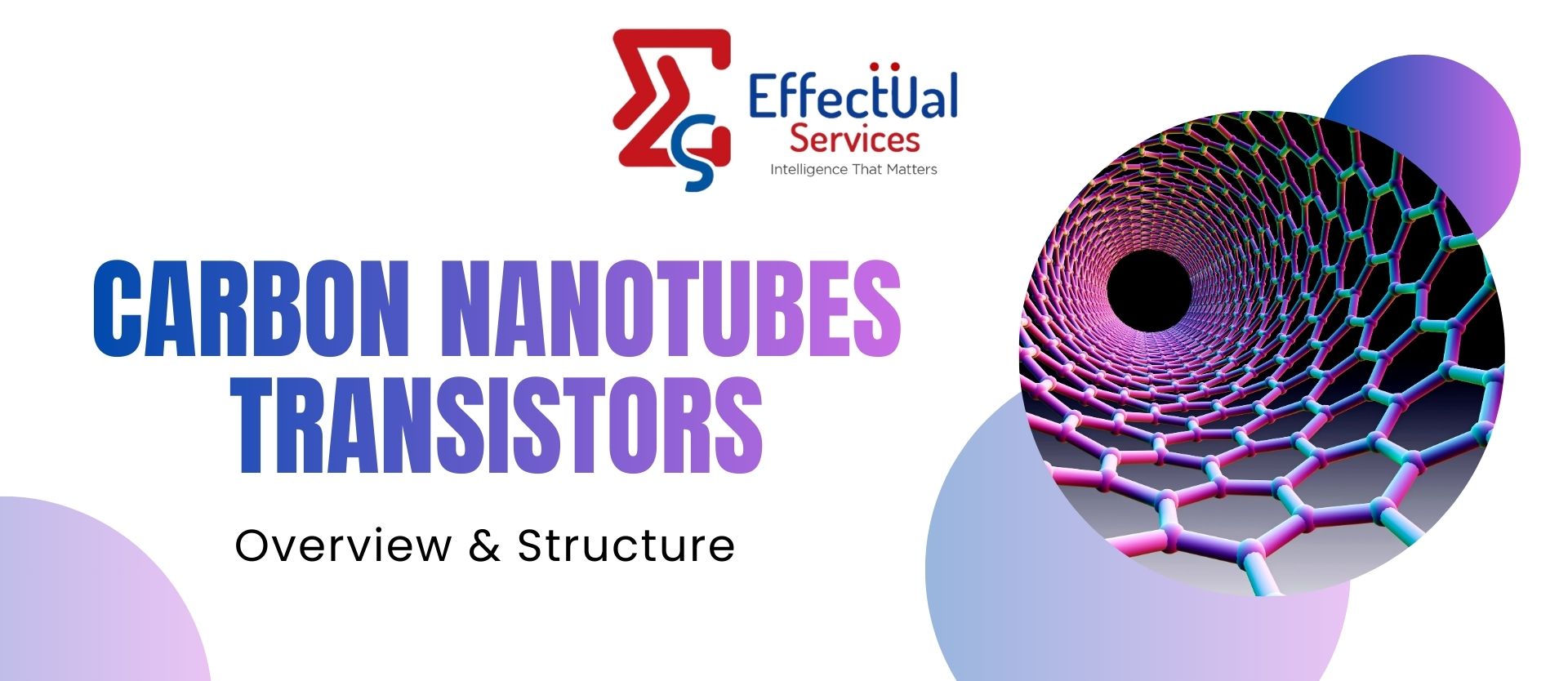
The development and advancements of carbon nanotube-based transistors (CNT-TFTs) is a next-generation alternative to traditional silicon-based transistors the electrical, mechanical, and thermal properties of carbon nanotubes (CNTs). This study aims to analyze that enable high-performance transistor applications. It will also examine recent research breakthroughs, fabrication techniques, scalability challenges, and potential commercial applications in nanoelectronics, flexible electronics, and high-speed computing. By assessing the advantages, limitations, and future prospects of CNT transistors, this study provides insights into their role in advancing semiconductor technology.
We understand that scope of study is worldwide.
- The report answers the following questions –
- What are the technology available for Carbon Nanotube-Based Transistors?
- Recommendation on solving some major problems for Carbon Nanotube-Based Transistors. These problem includes:
- Uneven distribution
- Overlapping
- Clumping
- Low density.
- Difficulty in controlling the spacing between the nanotubes.
- Design Complexity.
Carbon Nanotube Transistors (CNT-TFTs) are an emerging class of nanoelectronic devices that utilize carbon nanotubes (CNTs) as the primary channel material instead of traditional silicon. These transistors offer significant advantages due to the unique properties of CNTs, including high electron mobility, excellent thermal conductivity, and superior mechanical strength.
Key Advantages
- High Performance: CNTs enable faster switching speeds and lower power consumption than silicon transistors.
- Miniaturization: Due to their nanoscale structure, CNT-TFTs can be scaled down beyond the limits of conventional silicon-based transistors.
- Flexibility: Ideal for flexible electronics and wearable devices due to their mechanical strength and flexibility.
- Energy Efficiency: Low operating voltage and minimal energy loss make them suitable for low-power applications.
Applications
- Next-Generation Processors: Potential replacement for silicon in high-speed computing.
- Flexible & Wearable Electronics: Used in bendable displays, smart textiles, and biomedical sensors.
- Low-Power IoT Devices: Ideal for energy-efficient wireless sensors and edge computing applications.
Structure of Carbon Nanotube Transistors (CNT-TFTs)
Carbon Nanotube Transistors (CNT-TFTs) are field-effect transistors (FETs) that use semiconducting carbon nanotubes (CNTs) as the channel material instead of silicon. Their structure is similar to conventional MOSFETs but with key differences that enable superior performance.
Key Structural Components:
1. Source and Drain Electrodes
- These electrodes provide the input (source) and output (drain) terminals for electron flow.
- Typically made of metals such as gold (Au), palladium (Pd), or titanium (Ti) to establish good contact with CNTs.
2. Carbon Nanotube (CNT) Channel
- A network or individual semiconducting CNTs bridges the source and drain, serving as the transistor's conductive path.
- CNTs can be randomly oriented (for flexible electronics) or precisely aligned (for high-performance transistors).
3. Gate Electrode
- Controls the flow of current through the CNT channel by applying a voltage.
- Can be top-gate, bottom-gate, or wrap-around gate, depending on the transistor design.
4. Gate Dielectric Layer
- An insulating layer (e.g., SiO₂, HfO₂) placed between the gate electrode and the CNT channel to control the electric field.
- Ensures efficient gate modulation and prevents leakage currents.
5. Substrate
- Supports the transistor structure, which can be rigid (e.g., silicon wafer) or flexible (e.g., plastic or polymer for flexible electronics).

Types of CNT Transistor Structures:
1. Back-Gated CNT-TFT
- The gate electrode is beneath the CNT channel, with a dielectric layer in between.
- Commonly used in early CNT transistor research.
2. Top-Gated CNT-TFT
- The gate electrode is above the CNT channel, providing better electrostatic control.
- More scalable and suitable for high-performance applications.
3. Wrap-Around Gate CNT-TFT (Gate-All-Around, GAA)
- The gate electrode fully surrounds the CNT channel, maximizing gate control.
- Enhances performance, energy efficiency, and transistor density for next-gen computing.
About Effectual Services
Effectual Services is an award-winning Intellectual Property (IP) management advisory & consulting firm offering IP intelligence to Fortune 500 companies, law firms, research institutes and universities, and venture capital firms/PE firms, globally. Through research & intelligence we help our clients in taking critical business decisions backed with credible data sources, which in turn helps them achieve their organisational goals, foster innovation and achieve milestones within timelines while optimising costs.
We are one of the largest IP & business intelligence providers, globally serving clients for over a decade now. Our multidisciplinary teams of subject matter experts have deep knowledge of best practices across industries, are adept with benchmarking quality standards and use a combination of human and machine intellect to deliver quality projects. Having a global footprint in over 5 countries helps us to bridge boundaries and work seamlessly across multiple time zones, thus living to the core of our philosophy - Innovation is global, so are we !!!
Solutions Driving Innovation & Intelligence


Enabling Fortune 500's, R&D Giants, Law firms, Universities, Research institutes & SME's Around The Globe Gather Intelligence That
Protects and Nurtures Innovation Through a Team of 250+ Techno Legal Professionals.