
Articles
AI-driven Robots Evolution, Innovation & Beyond
AI-driven Robots Evolution, Innovation & Beyond
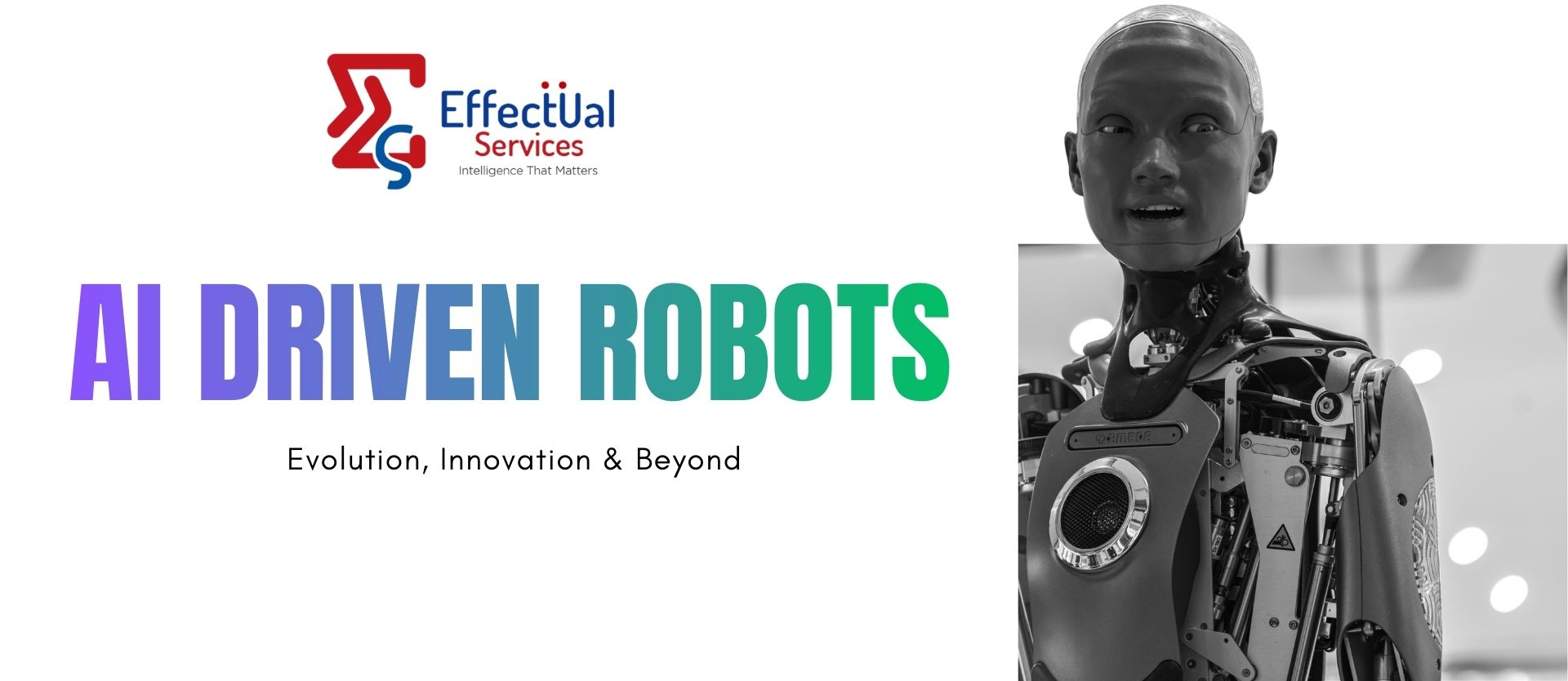
A robot is a mechanical device that is programmed to perform tasks automatically. AI robots use various technologies, such as 2D/3D cameras, proximity sensors, vibration sensors and accelerometers, to record countless measurement data, which they analyze and react to in real time.
How AI-Driven Robots works?
Intelligent robots are equipped with machine learning algorithms, allowing them to acquire knowledge from data, make decisions and improve their performance over time.
Data input comes from a variety of sources, such as sensors, cameras, and other perception devices. This data is then processed through neural networks, systems that mimic the structure and function of the human brain. During this process, the robot learns patterns and correlations, enabling it to perform specific tasks more efficiently.
Types of AI-Robots
- Autonomous Mobile Robots (AMR): They are able to move independently in their environment and perform tasks without human assistance. Companies use AMR in various areas, such as logistics, warehouses, manufacturing, healthcare and agriculture.
- Cobots: Cobots, also known as collaborative robots, work together with humans. Cobots are also able to respond to human speech and gestures without having to be trained by employees. Prices for cobots from Igus start at just under 3,000 euros.
- Articulated Robots: Articulated robots, also known as robotic arms or industrial robots, are mechanical devices with joints and arms that companies use to perform various tasks in industrial environments. These robotic arms are designed to perform human-like movements.
- Humanoid Robots: They have a mechanical body with arms, legs, and a head like that of a person's, and they can often walk and manipulate objects much like we do.
Evolution of AI-Robots
First Robot to Use Artificial Intelligence
- It was known as Shakey, developed by Stanford Research Institute in the 1960s.
- If you gave Shakey a goal — such as navigating its way across a room or pushing a box along the floor — it could accomplish it by observing the world around it, creating a plan, and executing.
- Shakey would gather data that enabled it to build a model of its environment and then use a "planning" program to generate its next moves.
Roomba (Vacuum cleaner)
- The popular Roomba, a robotic vacuum cleaner, was first released in 2002 by the company iRobot.
- Roombas have a set of sensors which help them navigate the floor area of a home. These sensors can detect the presence of obstacles and steep drops (e.g., to avoid falling down stairs).
- Roombas allow some modulation and reprogramming.
Sophia (Robot)
- Sophia is a female social humanoid robot developed in 2016 by the Hong Kong–based company Hanson Robotics.
- As of 2018, Sophia's architecture includes scripting software, a chat system, and OpenCog, an AI system designed for general reasoning.
- Sophia is also a framework for cutting edge robotics and AI research, particularly for understanding human-robot interactions and their potential service and entertainment applications.
Atlas (Robot)
- The world's most dynamic humanoid robot, our fully electric Atlas robot is designed for real-world applications.
- Atlas sees its surroundings with depth sensors to generate point clouds of the environment.
- Atlas is intended to aid emergency services in search and rescue operations, performing tasks such as shutting off valves, opening doors and operating powered equipment in environments where humans could not survive.
- On April 16, 2024, Boston Dynamics announced the retirement of Atlas on their YouTube channel.
Recent Technical Advancement in AI-Driven Robots
The fusion of Artificial Intelligence (AI) and robotics represents one of the most significant technological synergies of our time. This convergence is not just about robots becoming more intelligent; it's about embedding advanced AI into the very fabric of robotic technology, fundamentally transforming what robots can do and how they interact with the world around them.
Sensors and Computer Vision: These technologies allow robots to perceive their environment with a level of detail and accuracy that closely mimics human vision. Advanced sensors provide critical data regarding distance, motion, and even material composition, enabling robots to navigate and manipulate their surroundings with precision. Computer vision, powered by AI, allows robots to recognize objects, interpret visual data, and make informed decisions based on their observations. This combination of advanced sensing and vision capabilities is essential in applications ranging from autonomous vehicles navigating busy streets to robots performing intricate tasks in unstructured environments like warehouses or disaster zones.
Autonomy and Decision-Making: AI is pivotal in enhancing the autonomy of robots, allowing them to make complex decisions independently. By processing vast amounts of data and learning from past experiences, AI-enabled robots can assess situations and choose appropriate actions without human intervention. This level of autonomy is particularly evident in areas like autonomous drones, which can survey land, deliver packages, or conduct search and rescue operations with minimal human guidance.
Human-Robot Interaction: Through natural language processing and emotional recognition, robots are now capable of understanding and responding to human speech and non-verbal cues. This advancement has opened doors for robots to be more interactive and responsive in various settings, from customer service robots that can engage in meaningful conversations to companion robots that can provide social interaction and support. AI's ability to interpret and respond to human emotions is particularly groundbreaking, paving the way for robots that can adapt their behavior to suit the emotional state of the user, thereby creating more natural and engaging interactions.
About Effectual Services
Effectual Services is an award-winning Intellectual Property (IP) management advisory & consulting firm offering IP intelligence to Fortune 500 companies, law firms, research institutes and universities, and venture capital firms/PE firms, globally. Through research & intelligence we help our clients in taking critical business decisions backed with credible data sources, which in turn helps them achieve their organisational goals, foster innovation and achieve milestones within timelines while optimising costs.
We are one of the largest IP & business intelligence providers, globally serving clients for over a decade now. Our multidisciplinary teams of subject matter experts have deep knowledge of best practices across industries, are adept with benchmarking quality standards and use a combination of human and machine intellect to deliver quality projects. Having a global footprint in over 5 countries helps us to bridge boundaries and work seamlessly across multiple time zones, thus living to the core of our philosophy - Innovation is global, so are we !!!
Solutions Driving Innovation & Intelligence


Enabling Fortune 500's, R&D Giants, Law firms, Universities, Research institutes & SME's Around The Globe Gather Intelligence That
Protects and Nurtures Innovation Through a Team of 250+ Techno Legal Professionals.